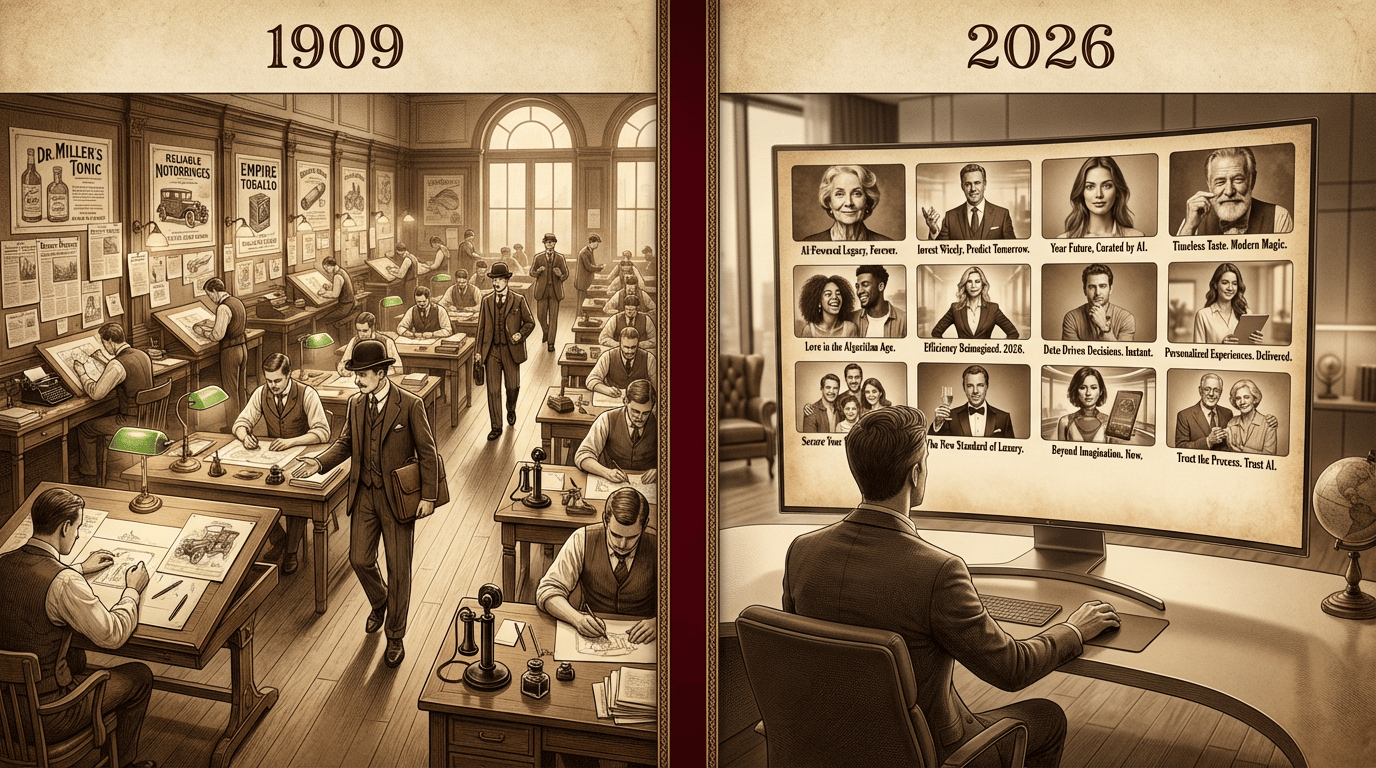
By 1909, J. Walter Thompson's New York office was the largest ad agency in the world. Account
men walked Madison Avenue clients through decisions; in the back room, staff illustrators bent
over drafting tables rendering next month's print ads in parallel. One operator oversaw dozens
of campaigns because the work was systematized. The production floor was the leverage.
1909 · JWT NYC
50 illustrators, drafting tables, parallel renders. One operator briefs the next ad
while the previous ten finish. The parallelism came from putting the work on a
production line.
2026 · one-operator
One screen, fifty AI-rendered variants this week. AI actors instead of illustrators,
rendered video instead of inked print. ~$110/mo and an afternoon for what cost a 1909
agency a fifty-person staff.
Thompson didn't write better ads than his competitors. He ran more of them, faster, in
parallel. The operator-test: ship the unit, then scale the line.
What goes wrong when one operator tries it solo
Three failure modes show up almost every time. Each one stops the factory before it produces
its second ad.
Trap 01
Designing the line before the unit ships
"How do I build a system that ships 50 ads a week?" before having shipped one. The
Thompson factory worked because the unit was repeatable — ship one, then the
next ten are the same workflow at scale.
Trap 02
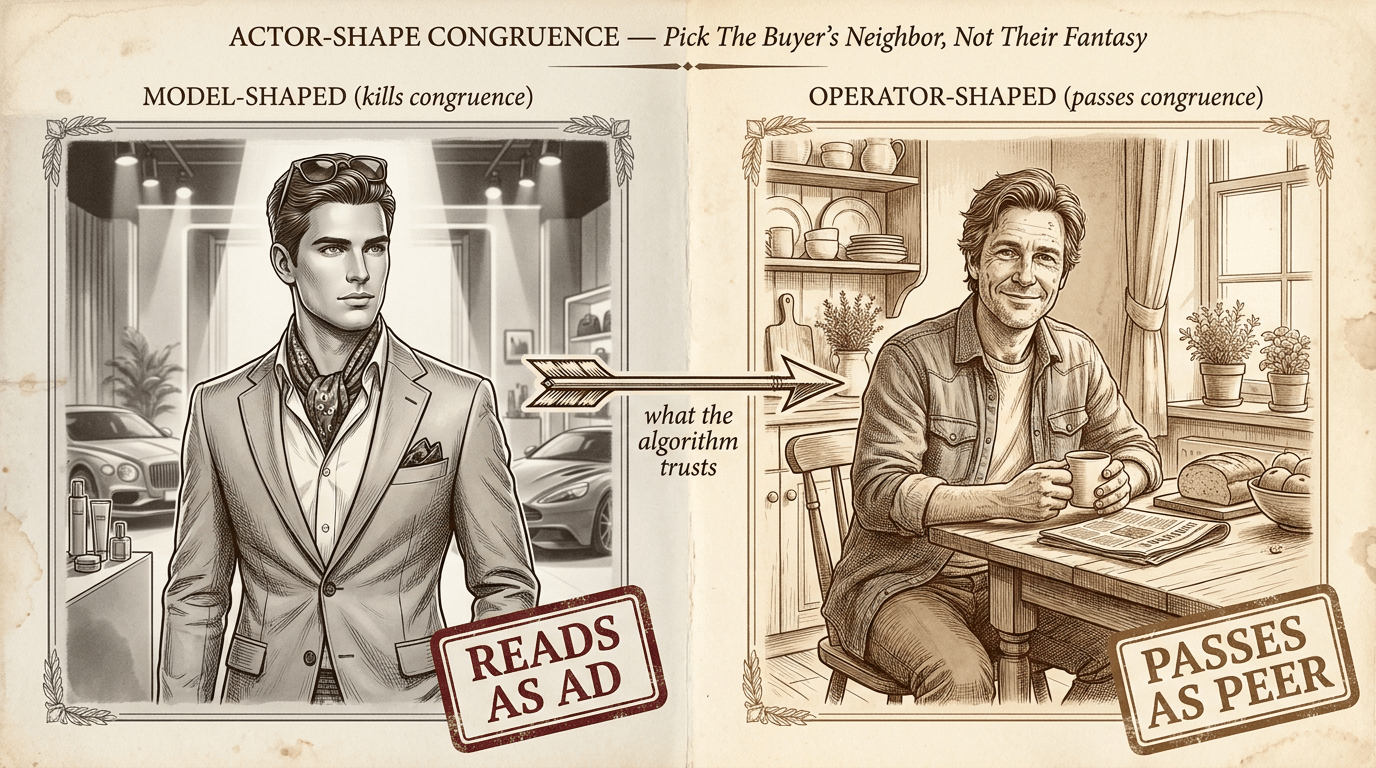
Model-shaped actors
First-time operators pick the polished, commercial-looking actors. Those ads read as
ads — to the algorithm and to the audience. Pick actors who look like the
buyer's neighbor, not the buyer's fantasy.
Trap 03
Script-variation, not hook-variation
50 variants of the same hook with reworded copy = A/B-testing one hook. Real iteration
is 5 distinct hooks rendered against the same offer. Parallel hooks, not parallel
rewrites.
The Arcads stack
Arcads
is the closest single-tool version of the Thompson production line, scaled to one operator.
Hundreds of operator-aged actors across casual / formal registers, multiple body types,
multiple ethnicities — the breadth is the point.
Library breadth
Hundreds
Operator-aged actors across age, body type, register, ethnicity. The "looks like your customer's neighbor" filter is wide.
Render reach
100+
Languages from one script template, native accent + lip-sync. Geo-expansion at one-operator cost.
Starter math
$110/mo
~30–40 ads/month at 1–3 credits each. Pro ($400/mo) handles agency-volume parallel-render.
Trial credits cover the first one or two end-to-end renders so the operator can learn the
workflow before paying. The audit happens on trial; the paid tier unlocks once the unit has
shipped. What Arcads is not: a video editor — renders need captions and cuts in
CapCut or
Vizard
before they're ad-ready. Render first, polish second.
What Arcads actually wins
Operator-aged actor library is the breadth pick. Hundreds of actors across ages, body types, registers, ethnicities. The "looks like your customer's neighbor" filter is wide enough to find a fit for almost any vertical. Other AI-actor tools have narrower libraries and lean model-shaped — the actors look like ads, not like people.
100+ language render is the leverage layer. One script template renders in English, Spanish, Portuguese, French, German, Italian, Japanese, Korean, etc., with native-sounding accent and lip-sync. The repurposing layer that used to require human voice actors per language now runs in parallel from the same template. Geo-expansion at one-operator cost.
Reasonable credit math at one-operator scale. Starter ($110/mo) at 1–3 credits/ad covers ~30–40 ads/month — enough for the first iteration cycle. Pro ($400/mo) handles agency-volume parallel-render. Pricing structure rewards weekly rendering cadences over one-shot bursts.
Where Arcads isn't the answer
Pre-validation operators with no shipped ad. The factory move only works when a unit exists to scale. Operators who haven't yet validated one offer with one ad shouldn't be optimizing the parallel-render layer. Solve "is this offer + this audience" first; render variants after.
B2B / enterprise-leaning audiences where AI-UGC reads as off-brand. Strict-trust verticals (medical, regulated finance, enterprise SaaS) often need higher-production-value video where the AI-actor "tell" undermines credibility. Synthesia or similar enterprise tools may fit better; or the answer is human-on-camera entirely.
Operators allergic to weekly creative cadence. Arcads's economics reward weekly rendering — the credit pool refreshes monthly, so under-using the Starter plan loses money. Operators who don't have the discipline (or the offer) to ship weekly should stay on lower-volume tools or the trial credits until the weekly rhythm exists.
Arcads vs. the alternatives
Same workflow runs on any of the four. The render layer changes; the discipline doesn't.
Enterprise-leaning teams running L&D, corporate training, internal-comms video at scale.
Enterprise-grade compliance, branded avatars, internal-use templates. The right pick for B2B/training motions where AI-UGC ad styling would be off-brand.
Narrow fit for solo-operator ad workflows. Avatar style reads more "explainer" than "talking-head ad" — not the right primitive for paid-social.
Walkthrough — the 5-step AI-UGC workflow
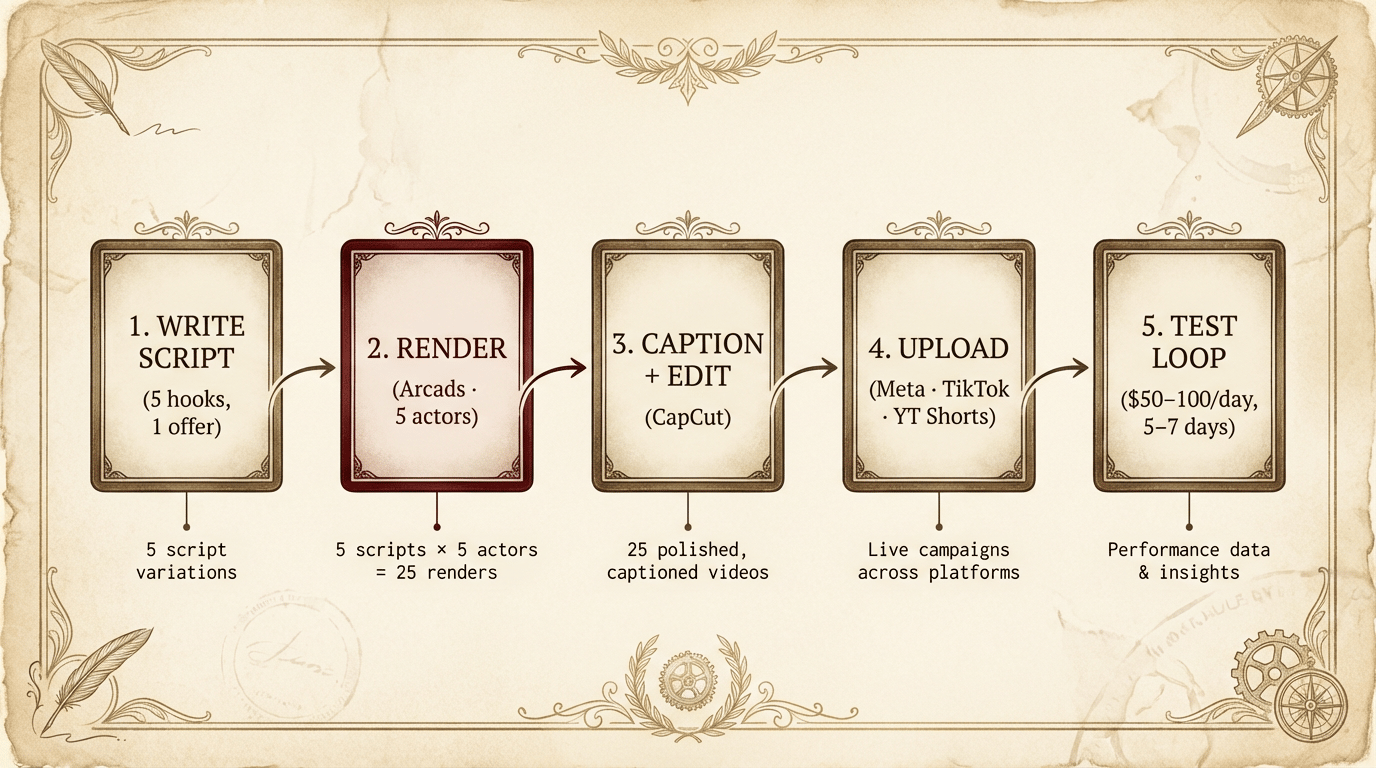
Write one script template (under 30 seconds spoken). Hook + problem + payoff + CTA. The hook is what gets tested — write 5 distinct ones (different angles, different framings) for the same offer. Keep the offer constant; vary the entry point. This is hook-variation, not script-variation. The factory move only compounds on parallel hooks.
Pick 5 actors from the Arcads library. Match your audience — operator-aged, casual register, not model-shaped. Different ages / body types / ethnicities for actor-fit testing. Each script will render against each actor (5 hooks × 5 actors = 25 ads on the first pass; trim to top 10 after a quick visual review).
Caption + edit in CapCut or Vizard. Arcads outputs raw video; the ad-ready cut needs captions (sound-off-default), B-roll if relevant, and a 3-second hook freeze-frame. CapCut handles this for free; Vizard automates more but costs $30+/mo. For a first run, CapCut is sufficient.
Upload to ad account. Meta, TikTok, YouTube Shorts — same render works across all three with platform-native sizing handled at upload. Tag the variants by hook + actor in the ad account naming convention so the post-launch reporting maps back to the matrix.
Test loop schedule. Run the variants on a small budget ($50–100/day per platform) for 5–7 days. The winners reveal themselves on CTR + CPM by hook. Kill the losers, double the winners, render the next 25 variants in the next iteration. The factory move is the loop, not the first batch.
Frequently asked
Does Arcads work for B2B?
Mixed — depends on the audience layer. B2B-SMB (under 200-employee company,
owner-operator-heavy buyer) responds well to talking-head AI UGC because the buyer is
functionally consumer-shaped. B2B-enterprise (large-org procurement, committee-buying)
usually doesn't — the production-value mismatch reads as off-brand.
Synthesia
or human-on-camera fits better for enterprise. Test the SMB layer first; don't generalize
from a 50-employee SaaS test to a Fortune-500 outreach motion.
How many ads should I render in the first week?
5 hooks × 5 actors = 25 ads on the first pass. Trim to 10 after a visual-quality review
(kill the renders with bad lip-sync, weird actor expressions, off-brand framing). Run 5–7
days of paid-test on the surviving 10 across two platforms (Meta + TikTok). Iterate the next
batch of 25 based on which hook+actor pairs returned. The first batch is the calibration;
the second batch is the test.
Can I use my own face / video instead of the Arcads library?
Yes —
HeyGen
is the better tool for single-creator on-camera replacements (avatar trained on your face,
your voice, your speech patterns). Arcads's strength is the breadth of the actor library;
HeyGen's strength is the single-personal-brand replacement. If your offer benefits from a
recognizable founder face, HeyGen. If it benefits from buyer-mirroring (the actor looks like
the customer), Arcads.
What's the credit math at the Starter tier?
Starter ($110/mo) gives ~50–80 credits/month at the time of writing. At 1–3
credits per render, that covers 25–40 ads/month — enough for one full iteration
cycle of 25 ads + a small re-render budget. Pro ($400/mo) covers agency-volume parallel-render
(~150–250 ads/month). Plan switching is easy; start on
Arcads
Starter and upgrade when the Pro tier's credit pool starts feeling tight.
Ship the unit before optimizing the line. The factory move only compounds on the second batch — first you have to render the first one.