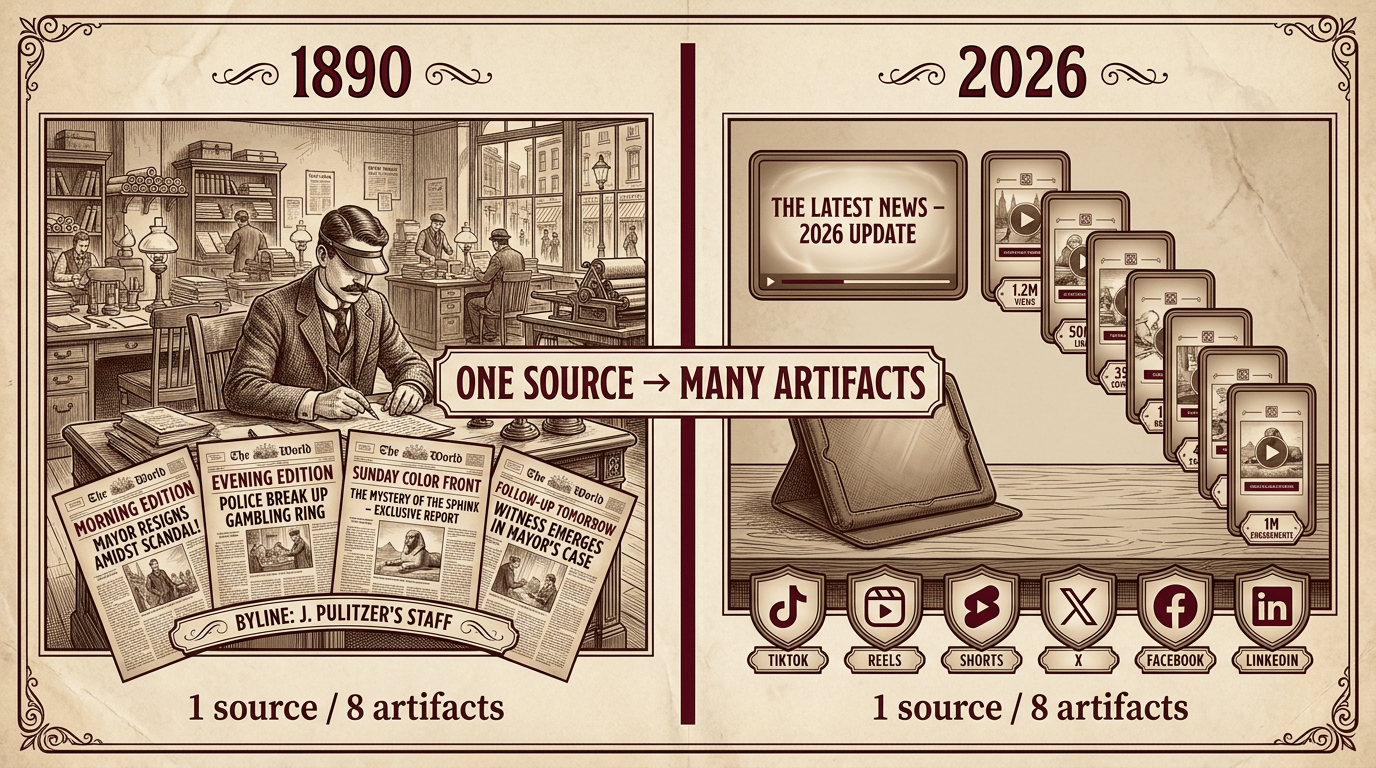
Pulitzer turned one story into many. Vizard turns one video into eight.
The 1890s editorial leverage was repurposing one source across morning, evening, and Sunday
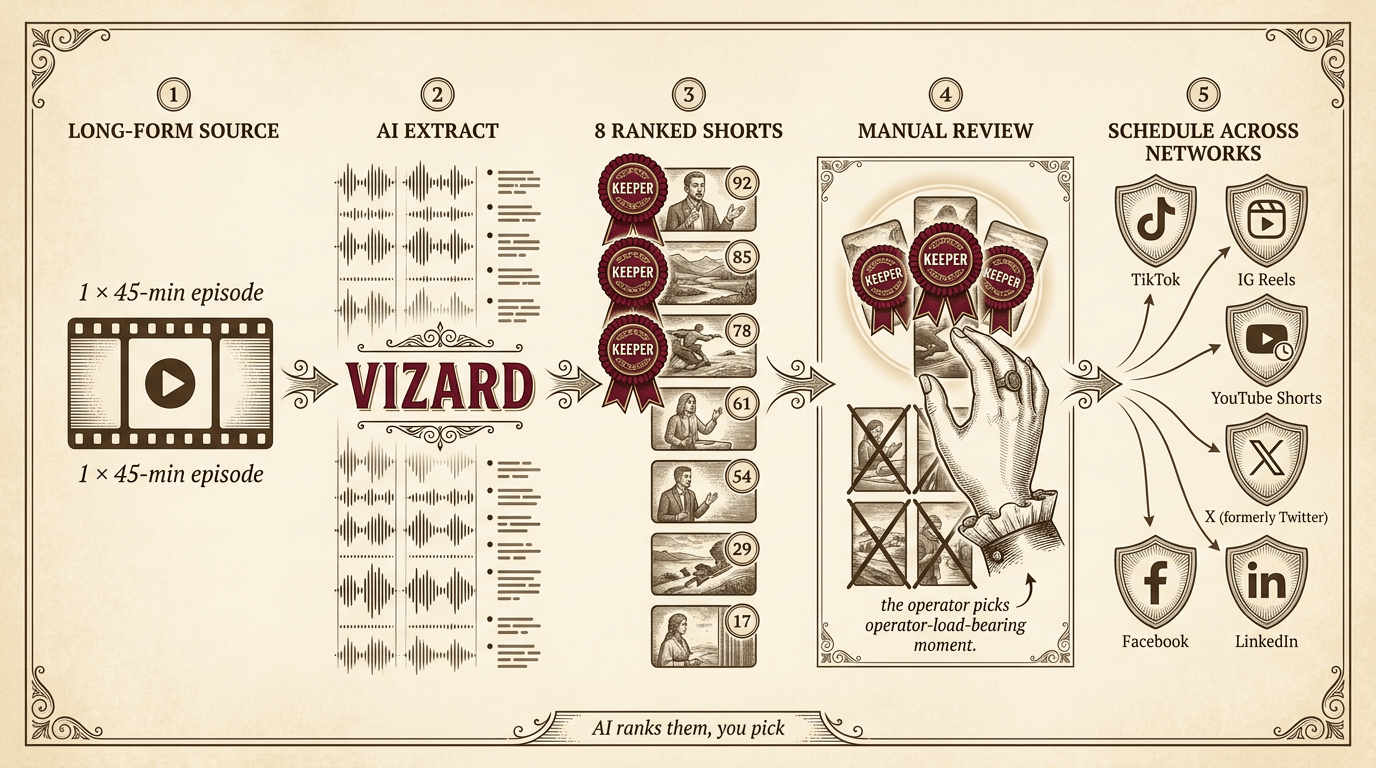
editions. The 2026 version is one long-form video → 8 ranked vertical shorts in 20
minutes of curation, not 6 hours of editing.
By 1890, Joseph Pulitzer's New York World was the largest-circulation paper in America. He
hadn't gotten there by writing more articles than competitors — he'd gotten there by
repurposing one source into many shaped artifacts.
By 1925
28
newspapers across America under the Pulitzer banner
Per investigation
3–5
distinct front-page artifacts from the same field reporting
Nellie Bly trip
72 days
one source, months of editorial output across formats
A single investigation typically ran across four shapes — morning lead with the sober
political angle, evening cut framed for the after-work human-interest reader, Sunday color
front with illustration and reformer interview, follow-up the next day extending the news
cycle. Same reporting, four artifacts, each landing on a different reader segment.
1890 · the World
One investigation. Reporter spends a week in tenement housing.
Four artifacts. Morning, evening, Sunday color, follow-up — same source, four shapes.
The leverage. More editors than competitors, each turning the source into a different angle.
2026 · the operator
One long-form. 45-minute podcast or YouTube essay shipped this week.
Eight artifacts. Vertical shorts ranked by AI virality — same source, eight shapes.
The leverage. AI ranking compresses the operator's pick-the-clip job from hours to minutes.
Writing is expensive. Repurposing is cheap.
— the Pulitzer editorial discipline, 1890–1925
What goes wrong when you don't repurpose
Most solo creators publishing long-form in 2026 have the inverse problem. They ship a
45-minute podcast, a 30-minute YouTube essay, a livestream replay — then open a fresh
Notion tab to write social posts from scratch. The long-form sits there unused. The social
tab competes with the long-form for the operator's writing time.
Tax 01
Watching back
1–2 hours scrubbing the full long-form to find 8 clip candidates worth cutting.
~15 min per clip face-tracking the crop frame so the speaker stays centered.
Six hours of editing work for what becomes eight shorts. After three or four of those
weekends, the operator quietly stops repurposing and the long-form just floats out as a
single artifact — the largest social acquisition channel of 2026 left on the
cutting-room floor.
The leverage point isn't writing more long-form. It's repurposing what's already published.
The Vizard stack
Vizard
is the AI-clip extractor we use internally for Old Money's own clip pipeline
(scripts/clips.py). It compresses the editing-from-scratch tax to a 20-minute
curation loop. Three primitives carry the workflow.
Leg 01
Extraction
AI parses the long-form for completed-thought moments, hook-shaped openings, audio peaks, and visual peaks. Default output: 8 ranked candidate clips. Configurable up to ~25 on paid tiers.
Leg 02
Ranking
Each clip scores 0–99 across four sub-factors (hook, completed-thought, audio, visual). Skim the top-8 in priority order instead of watching the whole long-form back — the ranking is the leverage, not the cutting.
Leg 03
Format
Face-tracked 9:16 reframe (crop follows the speaker). Bouncy captions baked in. Batch publish to TikTok, IG Reels, YouTube Shorts, X, Facebook, LinkedIn from one dashboard.
What Vizard isn't: an editing tool. It picks clips and reformats them; it doesn't let you
cut frames, restructure pacing, add b-roll, or graph timelines. If your motion needs deep
manual editing,
Opus Clip
is the polished alt; Descript or CapCut handle deep editing better.
What Vizard actually wins
AI ranking is the load-bearing leverage. The 0–99 virality score lets you skim the top-8 candidates in priority order instead of watching a 45-minute long-form back to find clip moments. The first three keepers usually come from clips ranked 80+; the bottom three from clips ranked under 60. That ranking is the time compression — without it, you're back to manual scrubbing.
Free tier covers a real test window. 60 credits/mo, 720p output, 3-day storage, watermark. One 45-minute upload eats ~45 credits — enough to validate the workflow on one long-form before paying $14.50/mo for Creator. Most clip tools either gatekeep AI ranking behind paid tiers or cap free at 1–2 minutes of input. Vizard's free tier is generous enough for an honest audit.
Authentic co-sign. We run Vizard internally for Old Money's clip pipeline at scripts/clips.py. Every Old Money episode's vertical clips ship through the Vizard API. The recommendation isn't a payout-driven pick — Vizard's affiliate math actually fails firm floor (lifetime payout caps at ~$58 per referral due to the 12-month commission window). The pick stands on "we use it ourselves," not on commission economics.
Where Vizard isn't the answer
Deep manual-editing operators. If your clips need precise frame-level cuts, restructured pacing, b-roll layered in, custom transitions, or graphical overlays, Vizard's auto-extract is too thin. Opus Clip is slightly more polished for solo editing; Descript and CapCut go deeper into manual control.
Sarcasm-heavy / comedic-timing-heavy content. Vizard's AI ranks well on hooks, completed thoughts, and audio polish. It misses sarcasm, comedic timing, audio-only payoffs, and content where the punchline is in what isn't said. If your long-form is comedy or commentary-driven, expect to override the AI ranking on at least half the picks. Manual review remains the load-bearing step.
Operators who don't yet ship long-form weekly. Vizard's leverage compounds when there's a steady supply of long-form to repurpose. If you're shipping <2 long-forms per month, the 60-credit/mo free tier is more than you need and the Creator tier doesn't pay back. Build the long-form habit first; layer Vizard once the supply is steady.
Vizard vs. the alternatives
Same workflow runs across all three. The platform changes; the discipline doesn't.
Solo creators with steady long-form supply who want AI ranking + format conversion + multi-network publish in one stack.
AI virality ranking (0–99 across four sub-factors) + face-tracked 9:16 reframe + Bouncy captions baked in + batch-publish API. The "we use it ourselves" pick.
Operators who already have shorts and need scheduling + analytics across the social stack.
Multi-network scheduling, analytics, competitor tracking. The "scheduling-and-analytics" pick.
Doesn't extract clips from long-form — different lane in the workflow. Pair with Vizard or Opus Clip upstream.
Walkthrough — the 4-step Vizard workflow
Pick the long-form source. Best targets: 30–60 minute podcast episodes, livestream replays, YouTube long-form essays. Avoid videos under 10 minutes (not enough source material to extract 8 distinct shorts) and over 2 hours (Vizard processing slows + free-tier credits get tight). The episode you published last week is the right input — recency keeps the clips topical.
Upload to Vizard's free tier. 60 credits/mo cap. One 45-minute upload typically consumes ~45 credits. Watermark on free; 720p resolution cap. Vizard processes in 10–20 minutes for a 45-minute source video. Output: 8 candidate clips with virality scores, captions baked in, 9:16 reframe applied.
Manual review — the load-bearing step. Open all 8 clips. Trust the ranking on the cleanest 50% of picks (clips scoring 80+); over-rule it on the bottom 30%. Kill clips where the AI missed sarcasm, missed a comedic payoff, cut on the wrong word, or grabbed a section where the audio carries but the visual doesn't (operator pacing back and forth without making eye contact, etc.). Keep 3–5 keepers from the 8.
Schedule across networks. Vizard's batch-publish pushes to TikTok, IG Reels, YouTube Shorts, X, Facebook, LinkedIn from one dashboard. Or download the keepers and schedule via your existing scheduler (Metricool, Buffer, Later, native platform). One keeper per day across 3–5 networks turns 20 minutes of curation into a week of social posts.
The discipline test at week's end: 5–7 social posts shipped without writing a single
new social-post draft. If you spent more than 30 minutes total on the loop, you over-edited.
Frequently asked
Can I really run this on the free tier, or is the credit cap too tight?
Free tier is 60 credits/mo, 720p, watermark, 3-day storage. One 45-minute long-form eats
~45 credits — enough to test the workflow on one source video per month. If you're
shipping weekly long-form, you'll exhaust free credits in week two and need to upgrade to
Creator ($14.50/mo) for unlimited usage. The free tier is for the audit, not the steady
state. Run it on one video, decide if the workflow earns the upgrade, then upgrade —
don't pre-pay before validating.
How does Vizard compare to Opus Clip — should I just use the polished one?
Both run the same workflow (AI extract → rank → reframe → publish).
Opus Clip
is more polished and has 1080p on its free tier, which matters for visual-heavy content.
Vizard wins on broader workflow features (more native publishing destinations including
Twitter and Facebook, which Opus skips) and the API-first design that lets foundry-style
automation pipelines integrate cleanly. For solo creators not running their own pipeline,
the choice mostly comes down to interface preference. Run both free trials on the same
long-form; pick the one whose top-8 ranking matches your taste.
What about Submagic / Descript / Munch / 2short — should I look at those?
Submagic is captions-specialist — redundant with Vizard's baked-in Bouncy captions
and Opus Clip's equivalent. Descript is full editing-suite, not a clip-extractor; it goes
deeper than Vizard but the workflow is hours, not minutes. Munch and 2short.ai are newer
entrants with similar AI-extract pitches but smaller user bases and less mature ranking
models. Vizard or Opus Clip are the two we'd recommend for solo creators in 2026 —
the rest are either feature-redundant (Submagic) or different jobs (Descript) or
earlier-stage (Munch, 2short).
Will this actually grow my audience?
Depends on the long-form. AI clip extraction compresses the production tax of
repurposing. It doesn't make weak content viral. If your 45-minute episode has zero hooks,
zero completed thoughts at the right length, and zero on-camera energy, Vizard will
dutifully extract 8 weak clips that won't perform on any network. Repurposing amplifies the
existing signal — it doesn't manufacture one. Build the long-form quality first, then
layer the clip workflow.
What if I don't have any long-form content yet?
Start there. Ship one 30-minute talking-head video, one podcast episode, or one livestream
this week. Don't run the Vizard workflow on a 5-minute video — it won't extract 8
distinct shorts and the math doesn't work. Build the long-form supply first; Vizard's
leverage compounds once you're shipping weekly. Until then, Vizard's free tier just sits
there waiting.
Pulitzer didn't write seven times. He repurposed one source into seven artifacts. The 2026 version is whatever you already published this week, ranked into 8 vertical shorts before the next long-form ships.