← All notes · 8 min read

Sears mailed catalogs. You should mail too.

Every platform is rented. The email list is owned. Beehiiv is the modern Sears mailing infrastructure — free tier, native growth, native monetization.

Try Beehiiv free →
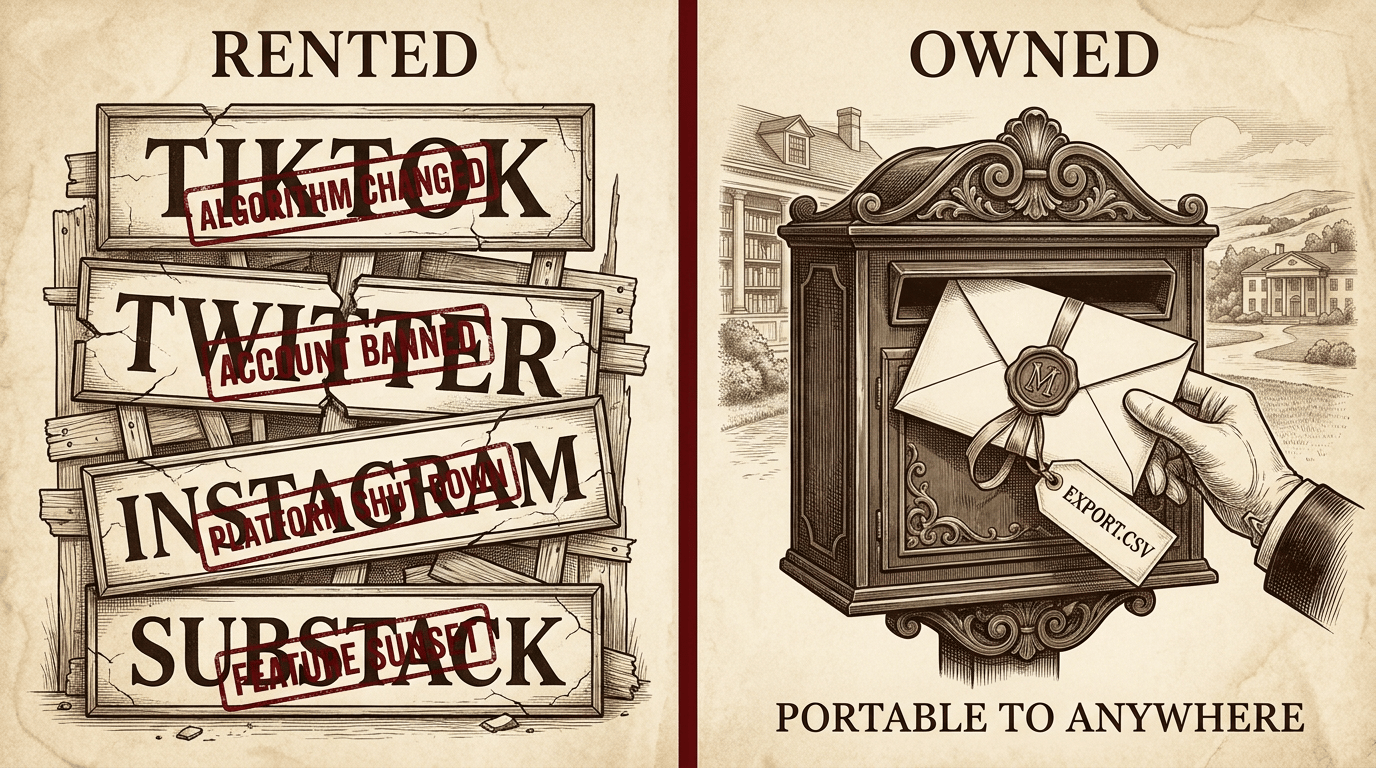
Rented-platform vs owned-list split — left: stacked TIKTOK / TWITTER / INSTAGRAM / SUBSTACK signs with oxblood ALGORITHM CHANGED, ACCOUNT BANNED, PLATFORM SHUT DOWN, FEATURE SUNSET stamps; right: a clean parchment-sealed envelope being placed into a 1900s American mailbox with an EXPORT.CSV ribbon and PORTABLE TO ANYWHERE caption.

The catalog was the list

By 1908, Sears was mailing millions of catalogs a year — for free — into roughly six million American mailboxes. He didn't sell the catalog. He gave it away because the catalog wasn't the product. The list was.

By 1908
~6M
American mailboxes receiving the Sears catalog twice a year
Cadence
30 yrs
that distribution rhythm ran for three decades unchanged
The moat
List
not the merchandise. Sears underpriced everyone, but the address list was the asset.

Competitors had storefronts; their relationship with the customer ended at the door. Sears had a relationship that lived in the kitchen drawer of every farmer who'd ever ordered from him — once a household was on the list, the relationship was effectively permanent. The 2026 version of that asset is the email list, and the test is the same: can you reach them tomorrow if the platform you built on disappears tonight?

The reader's email address is the relationship. The platform is just the mailing infrastructure.

What goes wrong when the audience is rented

Most operators in 2026 build their audience on a platform — 50,000 followers on TikTok, 10,000 on Twitter, 2,000 subscribers on Substack — and treat the platform as the product. The platform is the catalog. The platform owns the relationship. The operator borrows it.

Sears · 1908

The list lived in his ledger. If the mailing house went under, the relationship was still on his books — he could move it the next day.

Distribution was scheduled by the operator. Twice a year, on cadence, into the same drawers for thirty years.

Monetization was direct. Catalog → order → fulfillment. No platform middleman taking a cut.

Platform-renter · 2026

Algorithm shift drops reach 80% overnight. TikTok creators in 2024–2025 watched this curve in real time.

Account flag = years of work gone in 24h. Twitter 2022, Instagram 2023, every platform every year.

Monetization pivots and the relationship stops paying. Platform sunsets the feature; operator was the last to know.

Substack is a partial exception — the email list is exportable, which is more than TikTok or Instagram allow. But Substack still owns the discovery layer, the monetization layer, and the platform identity. An operator who exports the list to migrate still loses the recommendations engine, the Substack-bought subscribers, and the reader habit of opening "from Substack" emails. The list moves; the relationship doesn't fully come with it.

The Beehiiv stack

Beehiiv is the closest single-tool version of the Sears mailing infrastructure for 2026 newsletter operators. Three primitives carry the list-as-asset thesis — Beehiiv's stack handles all three natively.

Leg 01
Ownership
Every subscriber is yours. List export is one click; CSV is portable to Kit, ActiveCampaign, Mailchimp, anywhere. No platform-side holds, no data lock-in.
Leg 02
Growth
Recommendations network. Every newsletter on Beehiiv can recommend yours (and vice versa) — the closest 2026 analog to "the catalog is in every farmer's drawer." Boosts layer on once the list has scale.
Leg 03
Monetization
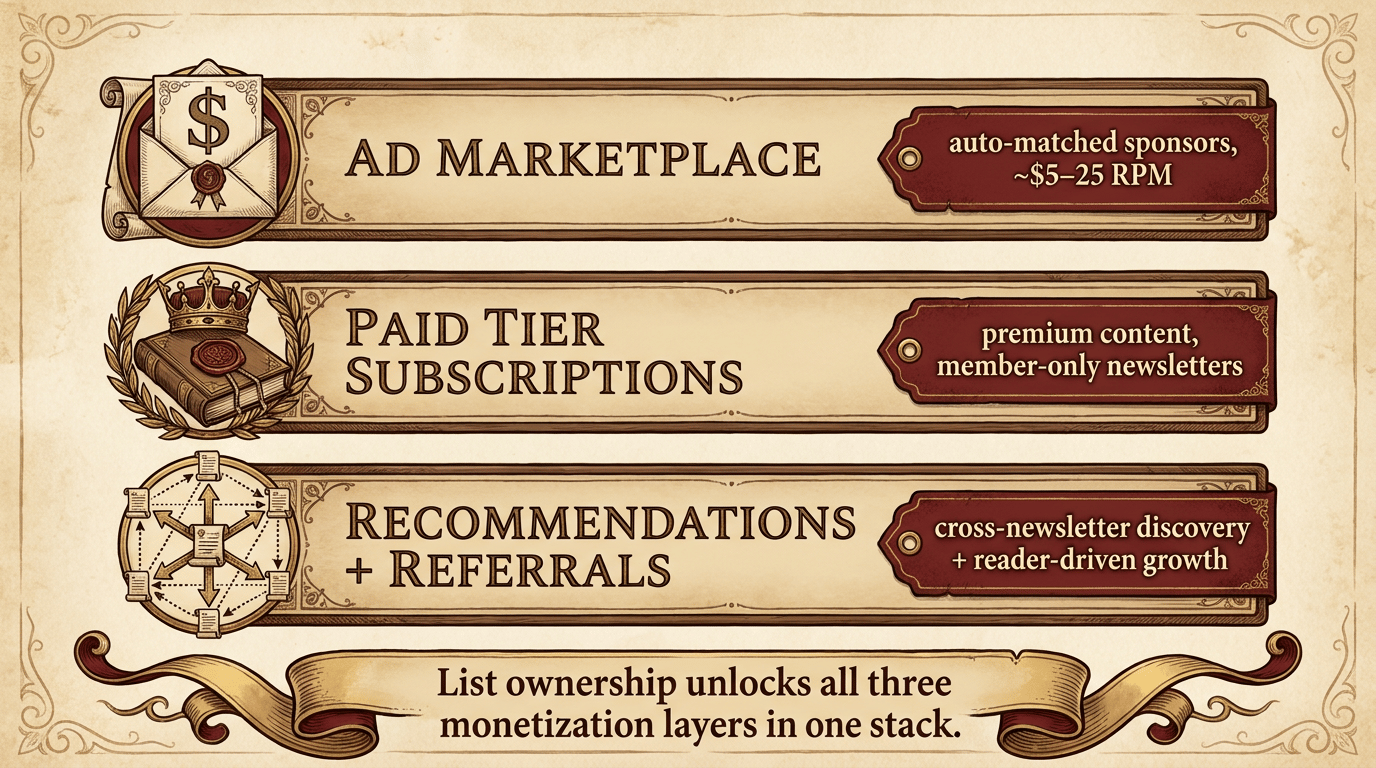
Native ad marketplace. Sponsors auto-match to newsletters that fit their audience profile. No agency middleman, no rate-card negotiation, no manual ad-ops. Paid tier + referral programs layer on top.

What Beehiiv is not: an automation platform. If your motion needs visual workflows, conditional sequence branching, deep CRM tagging, or commerce-funnel integrations beyond a basic paid-tier checkout, Beehiiv isn't the right primitive.

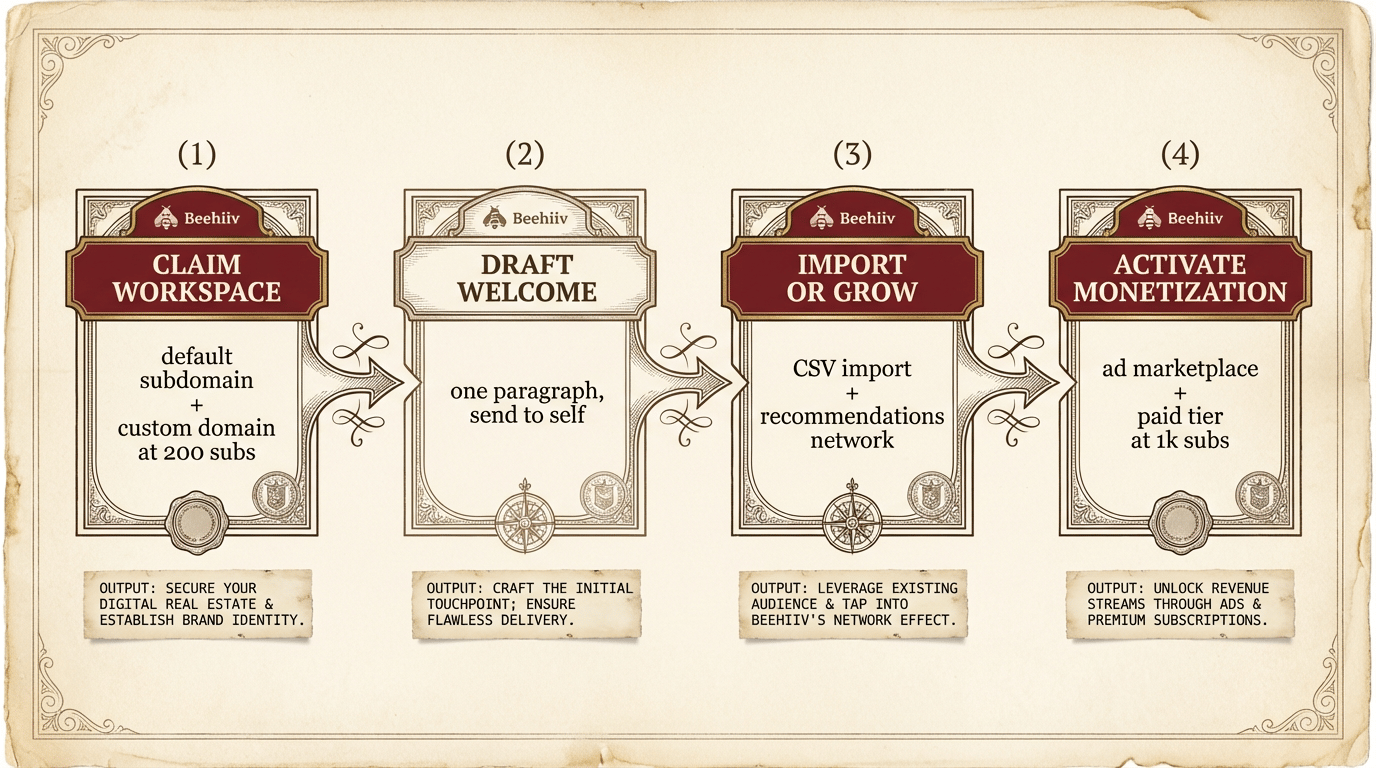
Four-step Beehiiv setup walkthrough: CLAIM WORKSPACE (default subdomain + custom domain at 200 subs) → DRAFT WELCOME (one paragraph, send to self) → IMPORT OR GROW (CSV import + recommendations network) → ACTIVATE MONETIZATION (ad marketplace + paid tier at 1k subs).

What Beehiiv actually wins

  • Free tier covers a real audit window. 2,500 subscribers free, full-feature access to growth + monetization tooling. The audit happens on free; the paid tier ($39/mo Launch) unlocks once the list has scale. Most newsletter platforms either gatekeep growth tools behind paid tiers or cap free at 1,000 subs — Beehiiv's free is generous enough to validate the motion before paying.
  • Recommendations network is the structural growth lever. Other newsletters on Beehiiv can recommend yours; your readers can recommend theirs. The network effect compounds at platform-level — every newsletter that joins makes every other newsletter on the platform slightly more discoverable. This is the closest thing to organic distribution any newsletter tool offers in 2026.
  • Native ad marketplace removes the monetization friction. Sponsors auto-match to newsletters that fit their target audience; the operator approves or rejects each placement. No sponsor outreach, no rate-card negotiation, no agency cut. For newsletter-native operators (not creator-economy folks adding email as a side channel), this is the cleanest path from "list of subscribers" to "list-funded business."

Where Beehiiv isn't the answer

  • Deep marketing automation operators. If your motion needs Zapier-tier conditional sequences, cross-platform automation, or CRM-level tagging, Beehiiv is too thin. ActiveCampaign is the depth pick for that side of the work — we use it internally for Old Money's own drip, and the difference shows once your sequences cross 5+ branches.
  • Commerce-heavy creator stacks. Operators selling courses, memberships, or digital products as primary revenue (with email as a delivery / nurture layer) are better served by Kit's commerce integrations and creator-economy tooling. Beehiiv handles paid-tier subscriptions but isn't built for the broader funnel.
  • Designer-aesthetic priorities. Flodesk dominates the "every email looks like a magazine spread" market. Beehiiv's templating is functional, not designed-first. If newsletter aesthetics is a primary differentiator (visual brands, creators-as-publishers), Flodesk is the right primitive.
Three-layer monetization stack: AD MARKETPLACE (auto-matched sponsors, $5–25 RPM), PAID TIER SUBSCRIPTIONS (premium content, member-only newsletters), RECOMMENDATIONS + REFERRALS (cross-newsletter discovery + reader-driven growth). List ownership unlocks all three monetization layers in one stack.

Beehiiv vs. the alternatives

Same workflow runs on any of the four. The platform changes; the discipline doesn't.

Tool Best for the newsletter-as-asset job Where it wins Where it doesn't
Beehiiv Newsletter-native operators who want list ownership + native growth + native monetization in one stack. Recommendations network + native ad marketplace + generous free tier (2,500 subs). The "Sears mailing infrastructure" pick. Thin on automation depth. Commerce-heavy creator stacks fit better elsewhere.
Kit Digital-product creators (courses, memberships, communities) using email as part of a broader creator stack. Visual automations, sequences, tags, native commerce integrations. The "creator stack" pick. Less newsletter-discovery infrastructure than Beehiiv. No native ad marketplace.
ActiveCampaign Operators with multi-branch automation needs, CRM-level tagging, conditional sequence depth. Deepest automation logic at prosumer pricing. The "marketing-automation" pick. We use this internally for Old Money's own drip. No native newsletter-discovery layer. Steeper learning curve than Beehiiv or Kit.
Flodesk Visual-brand operators where newsletter aesthetic is the differentiator. Flat-fee pricing predictability. Designer-aesthetic templating. Flat $38/mo regardless of list size. The "every email is a magazine spread" pick. No newsletter-discovery network. No native ad marketplace. Automation thinner than the others.

Walkthrough — the 4-step Beehiiv setup

  1. Claim the workspace + domain. Beehiiv free tier doesn't require a custom domain; the default yourname.beehiiv.com works for the audit phase. Once the list has 200+ subs, claim a custom domain (mail.yoursite.com or newsletter.yoursite.com) — sender-domain reputation compounds; build it on a domain you own from week one.
  2. Draft the welcome email — one paragraph. Not a 10-step funnel onboarding, not a "here's everything I'll send you" manifesto. One paragraph that names what the reader signed up for, what the schedule is, and what the next email will cover. Send it to yourself first; read it on mobile; ship it. The list isn't an asset until something arrives in someone's inbox; the welcome is the first arrival.
  3. Import or grow the list. If you have an existing list (ESP migration, platform export, lead-magnet form), import via CSV; Beehiiv handles compliance flagging automatically. If starting fresh, the recommendations network is the lever — turn it on, set up your "recommended newsletters" list (the ones whose readers would also want yours), and the platform handles the cross-promotion. Expect 0→1k subscribers in 60–90 days at moderate effort; faster with paid Boosts.
  4. Activate the first monetization layer. Once the list crosses 1,000 subscribers, the ad marketplace becomes meaningful — sponsors start matching automatically. For paid-tier subscriptions (premium content, member-only newsletters), the feature is built-in; just toggle on and price. Don't activate monetization before the list has scale; sponsor-fit needs ≥1k engaged subs to deliver acceptable RPMs.

Frequently asked

Should I migrate from Substack to Beehiiv?

Depends on what you're optimizing for. If your motion is newsletter-native (newsletter IS the product, monetized via ad marketplace or paid tier), Beehiiv's recommendations + ad marketplace are structurally better than Substack's discovery + payout split. If your motion is creator-built-on-Substack (recognized brand, established Substack subscriber base, Substack-discovery-driven growth), the migration cost may exceed the gain — list export brings the email addresses but loses the Substack identity layer. Audit on Beehiiv's free tier first; decide after 90 days.

Can I use Beehiiv if I already have an email list on another tool?

Yes — list import is one click via CSV. Existing subscribers from Kit, ActiveCampaign, Mailchimp, or any ESP that supports export move into Beehiiv with engagement metadata intact. Send a "we've moved to a new platform" re-engagement email to the imported list before activating the regular schedule; subscribers who haven't engaged in 90+ days should be flagged for cleanup pre-import to protect deliverability.

What if my list has zero subscribers right now?

Start with the welcome email anyway. The welcome doesn't need a list; it just needs to exist. Once it's drafted and you've sent it to yourself, the next 90 days are about list-build via the recommendations network + a single lead magnet (one tight free resource that maps to the newsletter's promise). Don't try to grow the list before the welcome exists — the welcome IS the validation step that you have a clear audience promise.

Does the ad marketplace actually pay?

Yes, but the math depends on subscriber count + niche. Typical RPM ranges from $5 to $25 per thousand opens for newsletters in the 1k–10k range; higher for tight-niche professional audiences (B2B, finance, high-skill operator audiences) and lower for broad-consumer or low-engagement lists. Don't budget on ad revenue until the list has crossed 1k engaged subs and you've run 3+ ad placements to calibrate the actual rate.

Sears didn't sell the catalog. He gave it away because the catalog wasn't the product — the list was. The 2026 version of that asset is yours to build, on your own infrastructure, on your own schedule.

Start with Beehiiv's free tier →