Conwell sold one lecture 6,000 times. Kajabi makes that scalable.
Russell Conwell wrote “Acres of Diamonds” in 1869, delivered it six thousand times
across fifty-seven years, and funded Temple University from the proceeds. The lecture was a
recorded asset before the recording technology existed. Kajabi is the 2026 distribution
layer for that asset shape.
The asset existed before the distribution mechanism
Russell Conwell wrote “Acres of Diamonds” in 1869. He was twenty-six, a Baptist
minister in Lexington, Massachusetts, and the lecture was a single argument about
opportunity: the diamond mine you're looking for is in the ground you're already standing
on. He delivered it once at a small venue. Got booked for the next. By the time he died in
1925, he had delivered the same lecture six thousand times. He never wrote a second one.
Acres of Diamonds
6,000
Times delivered across a 57-year national circuit (1869–1925). Same content, new audience, new check.
Compound proceeds
~$20M
Equivalent today. Funded the first faculty of Temple University, chartered 1884.
Lectures written
1
The asset shape is a single well-outlined unit, not a course library. The unit compounds.
The platform — lecture halls, train schedules, booking agents — was downstream of
the asset existing. The lecture funded the institution. The institution outlived the
operator.
What matters from Conwell's arc for a 2026 operator
Lesson 01
Single well-outlined unit
Not "a course library." Not "an evergreen funnel." One lecture, one promise, one
tight delivery. The operator with that has something to sell six thousand times.
Lesson 02
Platform downstream of asset
Conwell didn't lease lecture halls in 1869. He wrote the lecture and walked into the
next available venue. The infrastructure showed up because the asset was already
generating bookings.
Lesson 03
Institution outlives operator
The asset's revenue compounds long past the operator's personal labor. The platform
alone doesn't do that — the asset shape does. Conwell died; Temple endured.
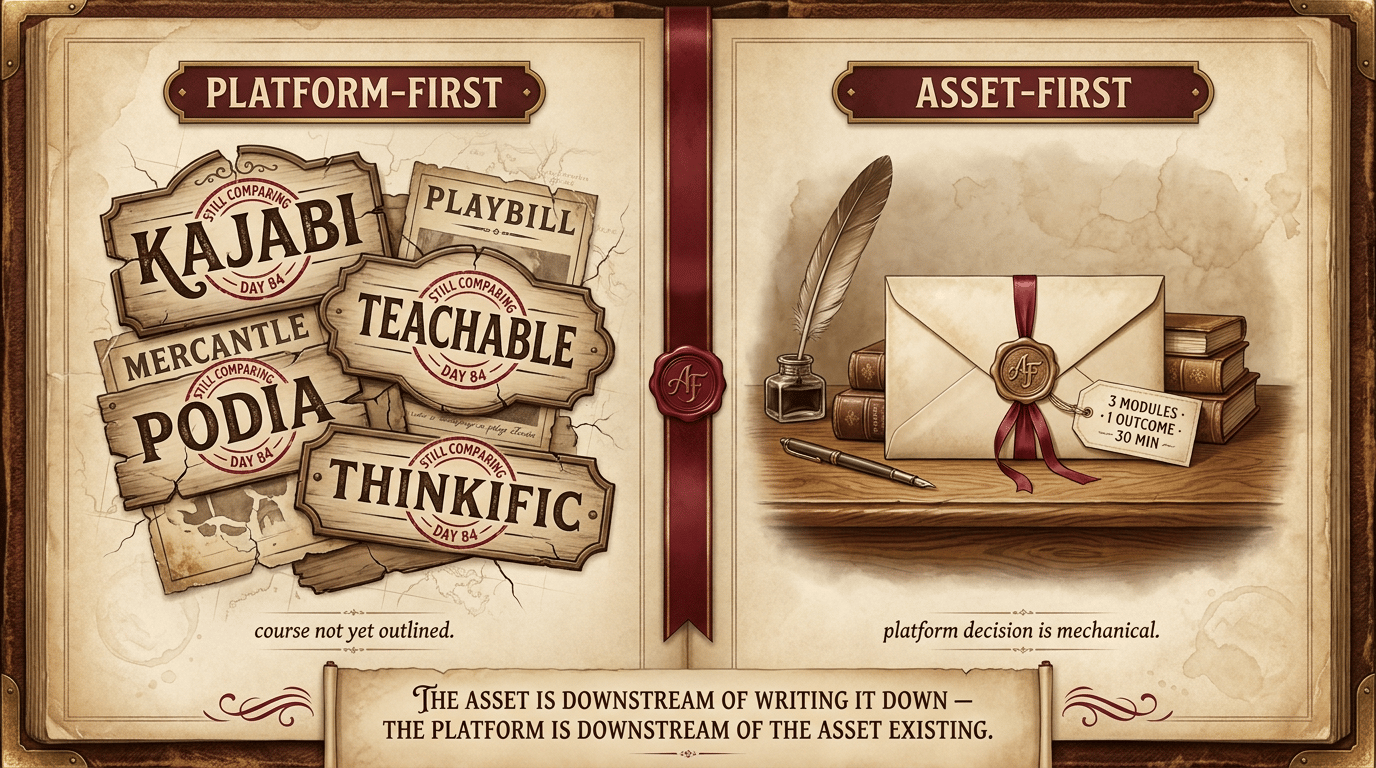
The platform-first failure mode
2026 · platform-first (the trap)
Open a Kajabi/Teachable/Podia comparison thread. Three weeks on platform research.
Pick. Sign up. Build the UI. Stuck on lesson #4. Abandon at month six. The course
never shipped because it never existed in outlined form.
1869 · asset-first (Conwell's order)
Write the lecture. Deliver it once at a small venue. Walk into the next venue. The
platform decision becomes mechanical because the asset is already generating bookings.
Outline first; platform second.
The diagnostic is one question: can you outline a 3-module course in 30 minutes on the
one thing you do better than ninety percent of your audience? If yes → the course
exists, platform-shop deliberately tomorrow. If no → the course doesn't exist yet,
and the action this week is finding the topic, not picking the platform. The outline tells
you whether the asset exists. The asset tells you whether the platform decision is worth
making.
The Kajabi stack
Once the outline exists, the platform decision becomes mechanical.
Kajabi
is the premium all-in-one pick — courses + drip lessons + email + community + sales
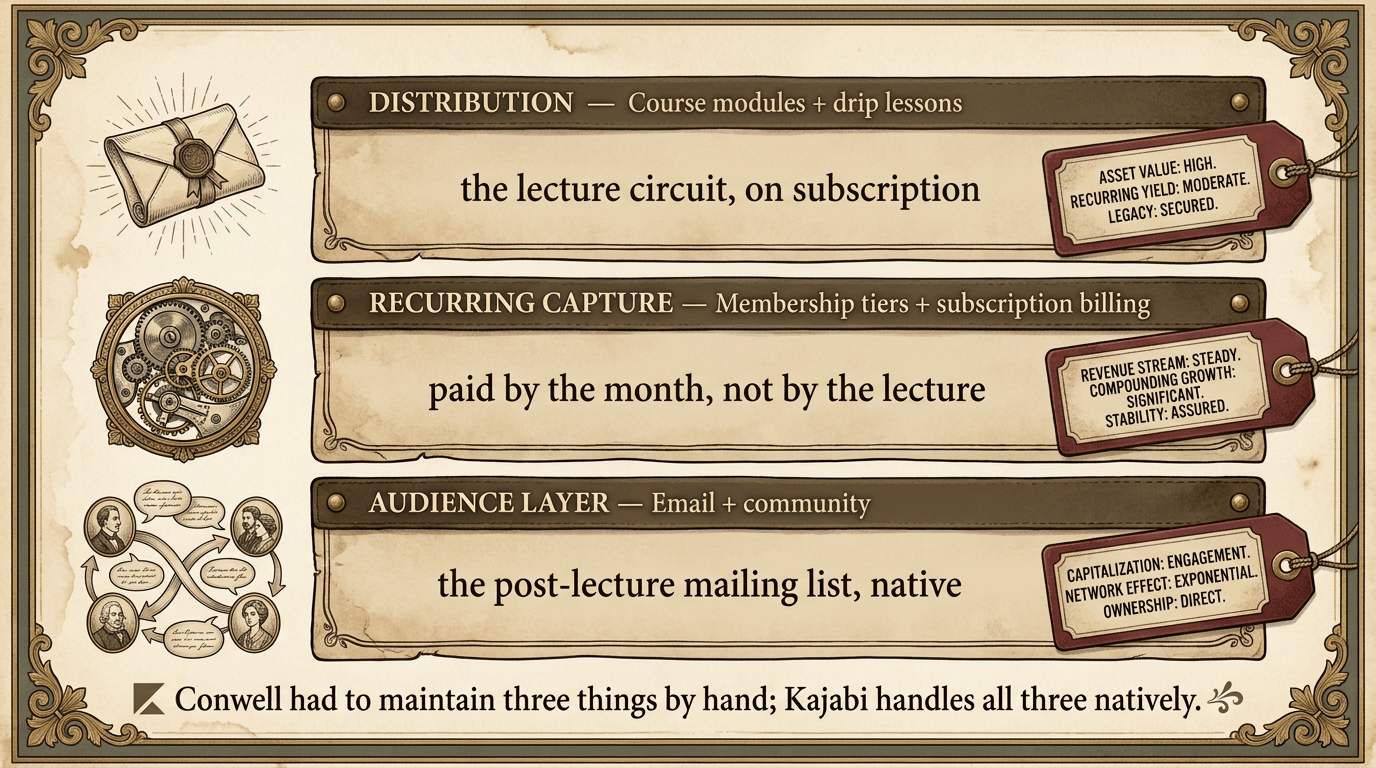
pages bundled in one stack. Three primitives matter for the recorded-asset thesis, and
Kajabi handles all three natively.
Layer 01
Distribution
Course modules + drip lessons + member-only access. Conwell's "deliver the same
lecture in a new city tonight" becomes "publish the same module to a new subscriber
tonight." Pacing handled by drip-by-day or unlock-by-event sequencing.
Layer 02
Recurring capture
Native subscription billing + membership tiers. Conwell got paid by the lecture;
Kajabi operators get paid by the month. Same long-arc revenue, different schedule,
no train tickets.
Layer 03
Audience-relationship
Built-in email + community. The post-lecture mailing list Conwell maintained by hand
becomes the email tool; lecture-attendee conversation becomes the community feature.
Bundled — no second SaaS.
Basic plan
$143/yr
Annual billing. Cheaper than Teachable Builder ($89/mo) once bundling kicks in.
Extended via partner link (vs default 14). Audit the bundling before paying.
What Kajabi is not: a discount platform. For operators running on free or sub-$30/mo
course tools today, the price step is real. The trade is depth-and-bundle — stop
stitching course/email/community/landing-page tools, pay one subscription for the whole
stack.
Teachable
and
Podia
handle course-only at lower price points; the comparison table below covers the trade.
What Kajabi actually wins
All-in-one bundling reduces stack complexity. Operators piecemeal-stacking course tool + email tool + community platform + landing-page builder spend non-trivial weekly time on integration drift (broken Zaps, mismatched contact records, double-entry). Kajabi consolidates the four most-stacked tools into one — one login, one subscriber record, one billing relationship. The time saved isn't dramatic on day one; it compounds at 6+ months when the integration debt would otherwise start eating the operator's calendar.
Course + membership + community on one record. The recurring-revenue thesis (Conwell's lecture-circuit equivalent) wants a single subscriber identity across course access, membership tier, and community participation. Teachable is course-only; Skool is community-first. Kajabi's bundle is the only mainstream option where one subscriber record carries all three layers, which matters when the operator wants tiered access (community-only / community + course / community + course + 1:1).
Sales pages + funnel builder included. Most course operators eventually build a landing page or sales-page funnel for paid tiers; Kajabi's page builder is included rather than requiring a separate ClickFunnels or Systeme.io subscription. Quality is solid (not best-in-class — see ClickFunnels for the sales-funnel-as-primary-asset operator), but for the operator whose primary asset is the course and the funnel is a delivery mechanism, included-in-stack is the right trade.
Where Kajabi isn't the answer
Course-only operators on a budget. If the operator's only product is a course, the operator's audience is small, and recurring tooling spend matters, Teachable's $89/mo Builder plan or Podia's $33/mo Mover (annual) cover the course layer for half the price. The bundling Kajabi sells doesn't matter to an operator who doesn't need the membership + community + funnel layers yet.
Community-first operators. If the actual asset shape is a community (paid membership, weekly cohort discussion, peer accountability) and the course is secondary, Skool is the depth pick. Kajabi's community feature is solid but not the platform's core; Skool's gamification + native discovery layer is structurally stronger when community is the product.
Operators who want best-in-class email automation. Kajabi's email tool is fine for course-delivery sequences and basic newsletter cadences; it's not ActiveCampaign-depth or Kit-creator-economy-depth. Operators with deep automation needs (5+ branched sequences, CRM-tagged conditional logic, cross-platform automation) will keep their dedicated email tool and integrate; the bundling argument weakens at that point.
Kajabi vs. the alternatives
Same workflow runs on any of the four. The platform changes; the discipline doesn't.
Solo digital-product sellers who want courses + downloads + webinars without Kajabi complexity.
Cheaper than Teachable. Cleaner UX for first-course operators. Mover at $33/mo annual is genuinely affordable.
5% transaction fee on Mover. Email marketing carved out as add-on past 100 subs. Affiliate payout capped at 12 months (vs Teachable's 30% recurring no-cap).
Community-first operators where the membership IS the product, course is secondary.
Native discovery (Skool Games, communities feed). Gamification keeps members engaged. The "audience graduates from subscriber to member" pick.
Course-builder is thin compared to Kajabi/Teachable/Podia. Not the right pick if the course is the primary asset.
Walkthrough — the 4-step Kajabi setup
Outline the course before the platform. Not on Kajabi, not on Teachable, not on Podia — on paper, in 30 minutes. Three module titles, one bullet per lesson within each module, one promised outcome per module. If you can fill the outline in 30 min, the course exists. If you can't, the course doesn't exist yet, and platform-shopping doesn't fix that. The outline is the validation step that you have something worth recording.
Claim the workspace + start the trial.Kajabi's 14-day trial (extended to 30 days via the partner link) handles the audit phase. Default subdomain (yourname.kajabi.com) works for the audit; custom domain (courses.yoursite.com or members.yoursite.com) goes on once the first module is recorded. Sender-domain reputation compounds for course-delivery emails — set up the custom domain in week one if the audit clears.
Build the first module live. Don't try to build all three modules before launching. Build module 1, gate it behind a free preview email signup, ship it to the first ten readers from your existing list (per Beehiiv or whichever email tool you already run). Watch what they do. The first ten reader-data points beat any pre-launch market research; ship module 2 after that signal lands.
Activate the recurring layer at scale. Once modules 1–3 are live and the course has shipped to fifty-plus paying customers, activate the membership tier (community + ongoing content drip + access to future modules) and the sales-page funnel for evergreen acquisition. The recurring layer is what gives Kajabi its real economic edge over Teachable/Podia — but it's only worth activating once the one-time course revenue has validated the asset.
Frequently asked
Is Kajabi worth $143/year (Basic) over Teachable's $89/month Builder?
Depends on whether you'll use the bundling. Kajabi Basic at $143/year (annual) is actually
cheaper than Teachable Builder at $89/month if you can pay annually, AND it includes the
membership + community + email + sales-page layers Teachable doesn't. The “Kajabi is
expensive” framing comes from the $179/month sticker (Basic, monthly billing) —
annual billing brings it under Teachable. If you'll use ≥3 of the bundled layers (course
+ email + community, or course + membership + sales pages), Kajabi clears the value test.
If you only need the course layer,
Teachable
Builder is the cheaper standalone.
Should I migrate from Teachable to Kajabi if my course is already shipped?
Probably not yet. Migration cost is non-trivial: course content re-upload, member-record
migration, payment-processor switch, sales-page rebuild, redirect setup for any external
links. Don't migrate unless one of these is true: (a) you've outgrown Teachable's
automation depth and the bundling matters, (b) you're adding a community + membership
layer that Teachable doesn't natively support, (c) you're consolidating multiple tools and
Kajabi replaces 3+ of them. If your motion is “I have a course on Teachable and it's
working” — leave it. The Kajabi-vs-Teachable decision matters at platform-pick
time, not at platform-switch time.
What if I'm using Skool for community + want to add courses?
Skool
has a courses module that's adequate for short-format / cohort-style courses. If your asset
shape is “community + curriculum delivered alongside community discussion,”
Skool's bundle works. If your asset shape is “structured course as primary product,
community as secondary engagement layer,” Kajabi's bundling is the right inversion
— courses native, community add-on. The decision criterion: which layer does the
customer pay for? If they pay for community access (with course as a perk), Skool. If they
pay for the course (with community as a perk), Kajabi.
Can I run my main email list on Kajabi instead of a dedicated email tool?
For most operators, no. Kajabi's email is fine for course-delivery sequences (welcome
series, lesson drips, member-only updates). It's not
Beehiiv-tier
on newsletter discovery + ad marketplace, not
ActiveCampaign-tier
on automation depth, not
Kit-tier
on creator-economy commerce. The right pattern: keep your dedicated email tool, integrate
Kajabi for course-delivery emails specifically. The bundling argument doesn't extend to
“Kajabi replaces my main ESP.”
Conwell wrote one lecture in 1869 and got fifty-seven years of revenue out of it. The asset is downstream of writing it down. Outline first; platform second.