← All notes · 8 min read

ClickFunnels vs Systeme: pick by stage, not by features

Rockefeller's vertical-integration move, applied to your funnel stack — and which tool actually fits where you are.

Try Systeme free →
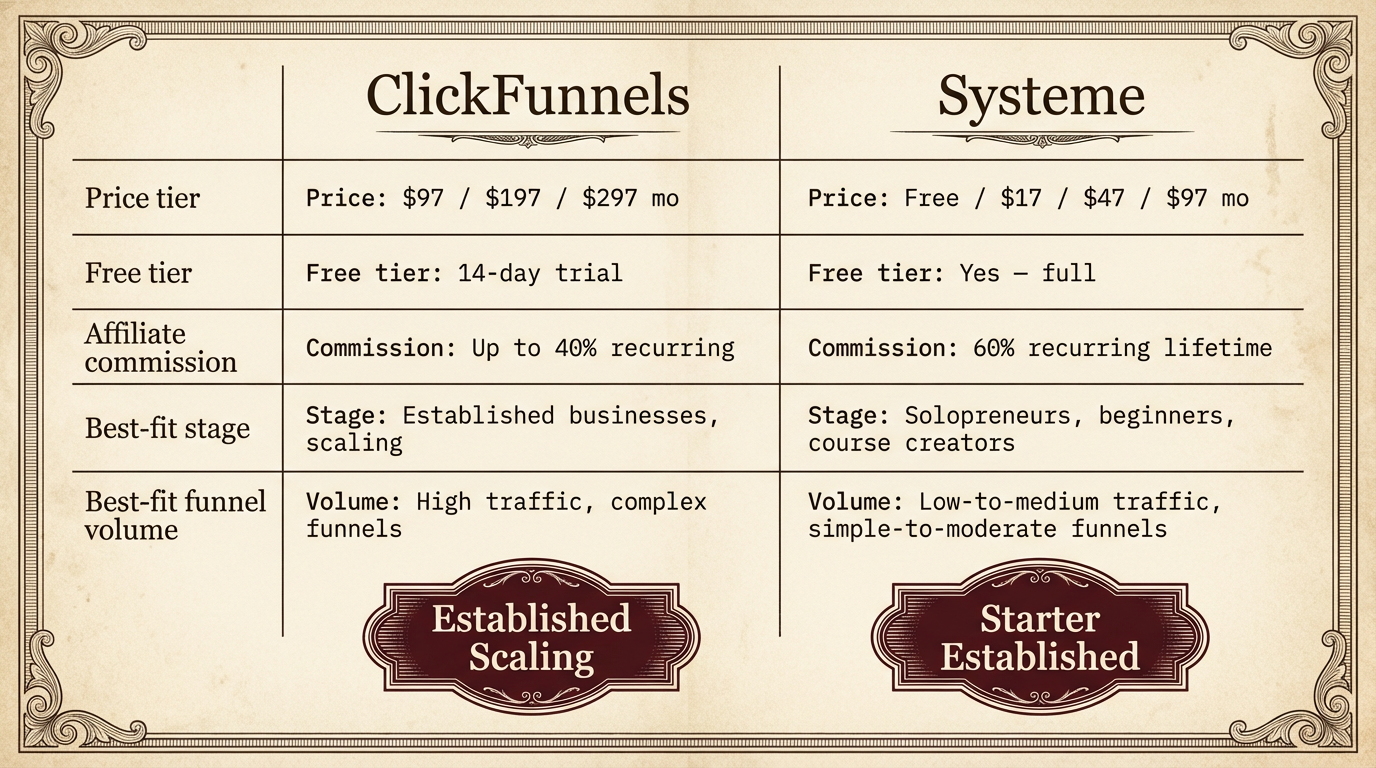
Side-by-side comparison: ClickFunnels vs Systeme.io feature/pricing matrix — five rows comparing price tier, free tier, affiliate commission, best-fit stage, and funnel volume; recommended-stage badges in oxblood at the bottom of each column.

The Rockefeller move, in 2026 funnel software

In 1882, Rockefeller's Standard Oil controlled 90% of American refining capacity. Not because Rockefeller refined oil better than anyone else — because he owned the pipelines that moved it, the cooperage that made the barrels, the railcars that hauled them to the coast. Every link between wellhead and gas station took a margin cut, and Standard Oil owned the cuts.

1882 · Standard Oil
90%
Of American refining capacity. Margin captured at every tier — refinery, barrel, railcar, depot.
Piecemeal stack
5+ tools
Email, checkout, course, calls, analytics. One subscription each, one seam each, one leak each.
All-in-one
5 tiers
Free magnet → tripwire → core → high-ticket → recurring. One stack owns the ladder.

Where the piecemeal stack leaks

1882 · the rail-and-barrel tax

Wellhead to gas station passed through a dozen hands. Every handoff added cost without adding value — rail tariffs, cooperage margin, depot fees. Rockefeller bought the handoffs.

2026 · the SaaS-seam tax

UTMs break between checkout and email. Abandoned-cart triggers run on Zapier flows that fail at 3 AM. Customer data lives in five places. Not money lost — revenue that never gets attributed.

The all-in-one funnel platform is the Rockefeller move applied to 2026. One stack, one domain, one customer record, one analytics view. Margin captured at every tier instead of leaked at every handoff.

Two tools dominate this category: ClickFunnels and Systeme. Both own all five tiers of the value ladder — free magnet, tripwire, core offer, high-ticket, recurring. The decision between them isn't about feature parity. It's about stage of funnel maturity.
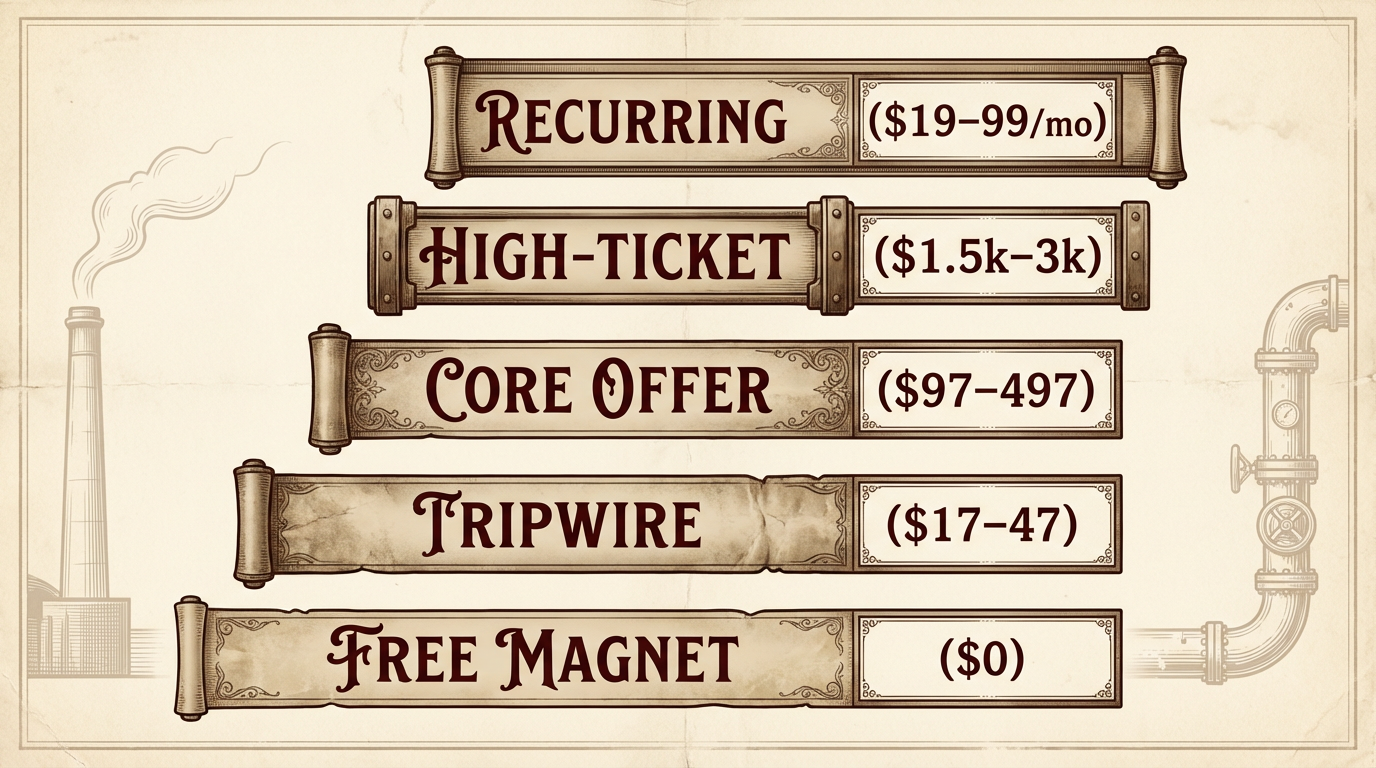
Five-tier value ladder diagram: Free magnet ($0) → Tripwire ($17–47) → Core offer ($97–497) → High-ticket ($1.5k–3k) → Recurring ($19–99/mo). Bars get progressively bolder up the ladder. Rockefeller-era refinery and pipeline motifs in the side margins.

What an all-in-one funnel platform actually wins

  • One customer record across the funnel. Every email, every purchase, every course-progress event lives on the same contact. No data fragmentation, no manual exports, no "wait, where did I see that customer's last action?" Cohort analysis works because the cohort is one record.
  • One billing relationship instead of five-plus SaaS subscriptions. Predictable monthly cost. No "small SaaS taxes" — $19 here, $39 there, $79 over there — quietly stacking to $400+/mo before you audit. One invoice, one renewal date, one cancellation lever.
  • Native analytics across the full funnel. See lead-magnet → tripwire → core conversion rates without stitching reports from four dashboards. Funnel-wide attribution is built in. The platforms know your conversion math even if you don't.

Where all-in-one isn't the answer

  • Course-heavy operators with established Kajabi setups won't get full LMS depth in either ClickFunnels or Systeme. If your course IS the primary product (10+ modules, drip schedules, completion certificates, member community), stay on Kajabi for the LMS layer and use a funnel platform only for the lead-capture / checkout side.
  • Multi-brand operators (running 3+ separate funnels for unrelated audiences) bump into all-in-one limits faster than expected. Account-switching friction makes ClickFunnels' Optimize tier ($297/mo) the only viable option for true multi-brand. Below that tier, you're juggling subdomains and contact-tag soups.
  • Heavy ecom (1k+ SKUs) belongs on Shopify, not a funnel platform. Funnel platforms are info-product / coaching / SaaS-pitch shaped — not catalog-shaped. Trying to run a 500-SKU store on a funnel builder is a bad time.

ClickFunnels vs Systeme — the comparison

Not a feature war. A stack-by-stage decision frame.

Tool Price Free tier Best stage
ClickFunnels $97 → $297/mo (annual ~17% off; Dominate $5,997/yr only) 14-day trial Established / scaling
Systeme Free → $17 → $47 → $97/mo Yes — full free tier (no card required) Starter / established

ClickFunnels has the bigger ecosystem — more templates, the OFA community, deeper integrations with the broader funnel-stack toolset. Systeme has the better unit economics for the operator (lifetime commission beats 30% recurring on a 24-month customer) AND for the buyer running it (free tier covers a real starter funnel). ClickFunnels is the industry default. Systeme is the operator's wedge.

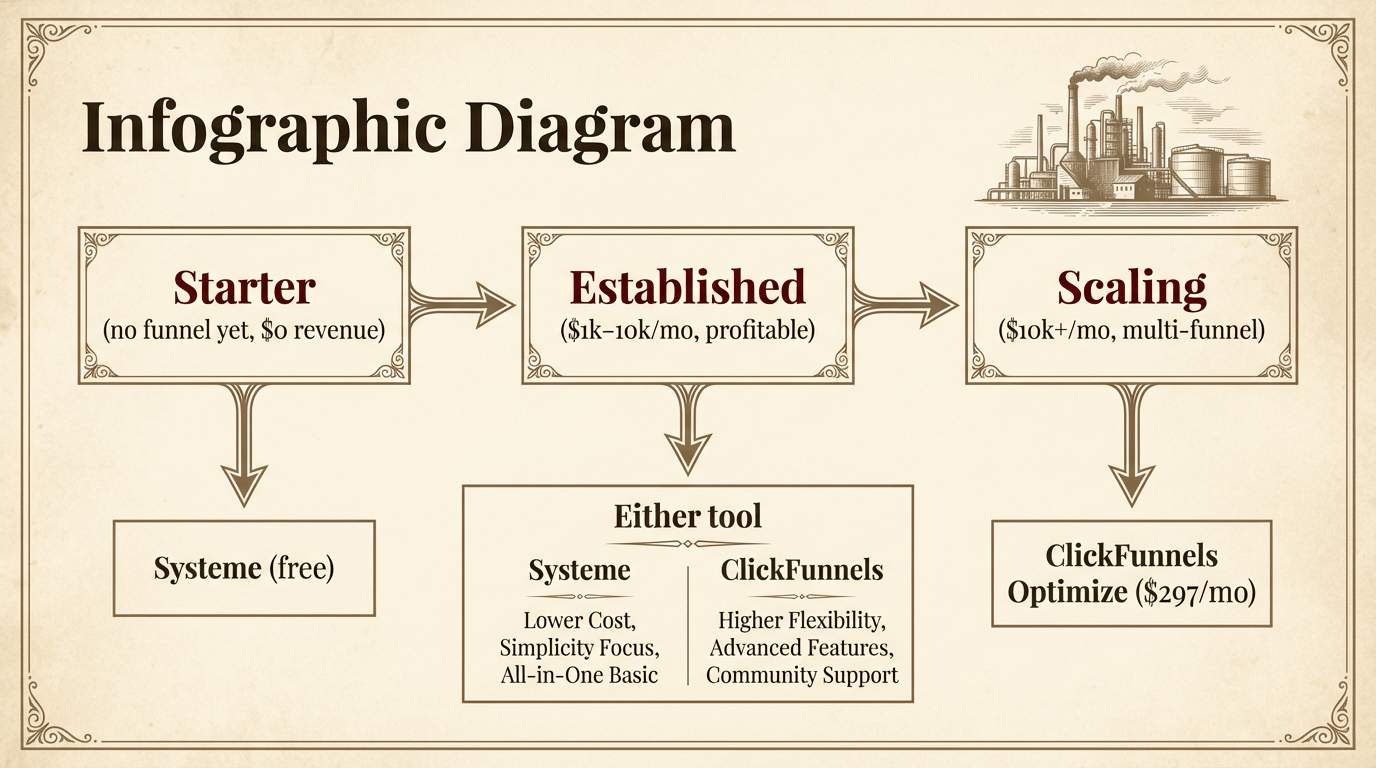
Three-stage decision diagram: Starter (no funnel yet, $0 revenue) → Systeme free; Established ($1k–10k/mo, profitable) → either tool; Scaling ($10k+/mo, multi-funnel) → ClickFunnels Optimize ($297/mo). Refinery silhouette anchor in the top-right.

Walkthrough — how to actually decide

  1. Audit your current funnel state. Open a notebook. Write down: do you have a lead-capture page running right now? A tripwire offer? A core offer? A high-ticket back-end? A recurring revenue line? If you don't have any of these, you're at starter. If you have one or two, you're early established. If you have all five running, you're scaling.
  2. Match tool to stage. Starter → start free on Systeme. The free tier handles real funnels (lead capture + email + one tripwire), and the upgrade path to $17/mo Startup is the cheapest in the category. Established → either tool works; lean Systeme for longer runway and better unit economics, ClickFunnels for the templates and ecosystem if you value the community side. Scaling ($10k+/mo, 2+ funnels, team or VA running it) → ClickFunnels Optimize tier ($297/mo) for the multi-funnel infrastructure and the integrations that compound at volume.
  3. Build one funnel end-to-end before building the second. The trap at every stage is opening tabs. Pick one offer, one funnel — lead-capture → tripwire → core. Get it converting. Then add the next tier on top. Don't build all five tiers in parallel; you'll ship none.
  4. Don't run both stacks in parallel. Stack-switching mid-build is a six-week setback. If you're starting fresh, pick one and commit. If you're migrating from a piecemeal stack, give the new platform 30 days before you decide it doesn't work — most "this tool sucks" complaints in week one are configuration learning curves, not product limits.
  5. Map back to the ladder before you ship. Open the playbook at play #2 (Rockefeller — Own the funnel) and run the audit move there: map your funnel on paper, circle every step you don't own. The all-in-one platform should erase most of those circles. The ones it doesn't erase are the integrations you still have to build manually — usually the LMS for course-heavy stacks, the CRM for sales-call-heavy stacks.

Pick the tool that matches the stage you're at, not the stage you want to be at. Migrate or commit after.

Start with Systeme free →