← All notes · 9 min read

Apollo + Lemlist: the cold-email stack Hopkins would build today

Reason-why advertising split across two tools — sourcing precision and cadence with reply tracking. List first, cadence second; most operators do the reverse.

Try Apollo free →
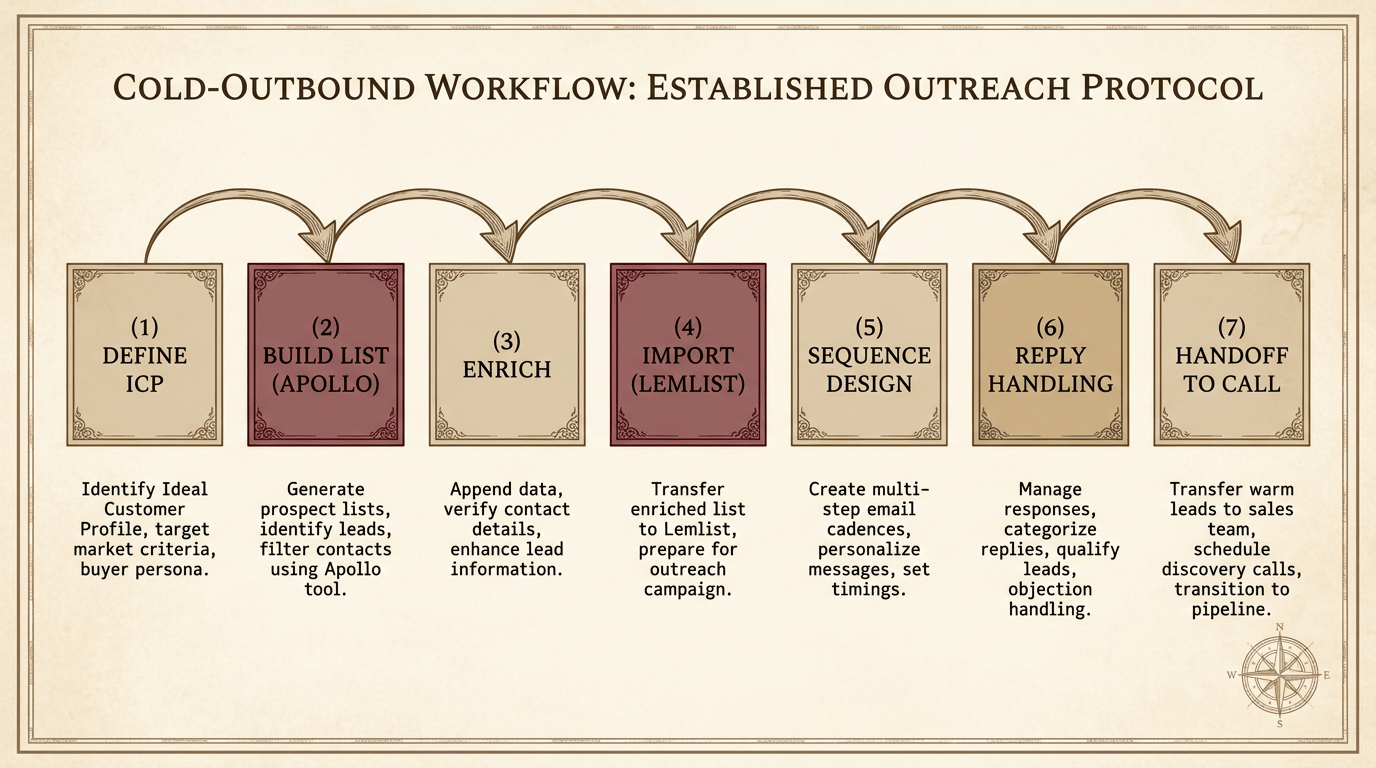
Cold-outbound workflow diagram: ICP → list-build in Apollo → enrich → import to Lemlist → sequence design → reply handling → handoff to call/inbox.

The Hopkins move, in 2026 cold email

Around 1919, Schlitz beer was near the bottom of American brewing. Same recipe as every competitor, same price, same channel. Then Claude Hopkins wrote one campaign — the copy that explained Schlitz sterilized every bottle in glass-enclosed rooms, filtered the water, cultivated the yeast for a decade. Same beer the competitors brewed; the operator-test detail printed for the consumer. Sales moved Schlitz to a tie for first place inside a year.

1919 · Schlitz
Tied #1
Bottom-half brewer to category leader inside a year — one campaign, one operator-test detail printed.
Hopkins's discipline
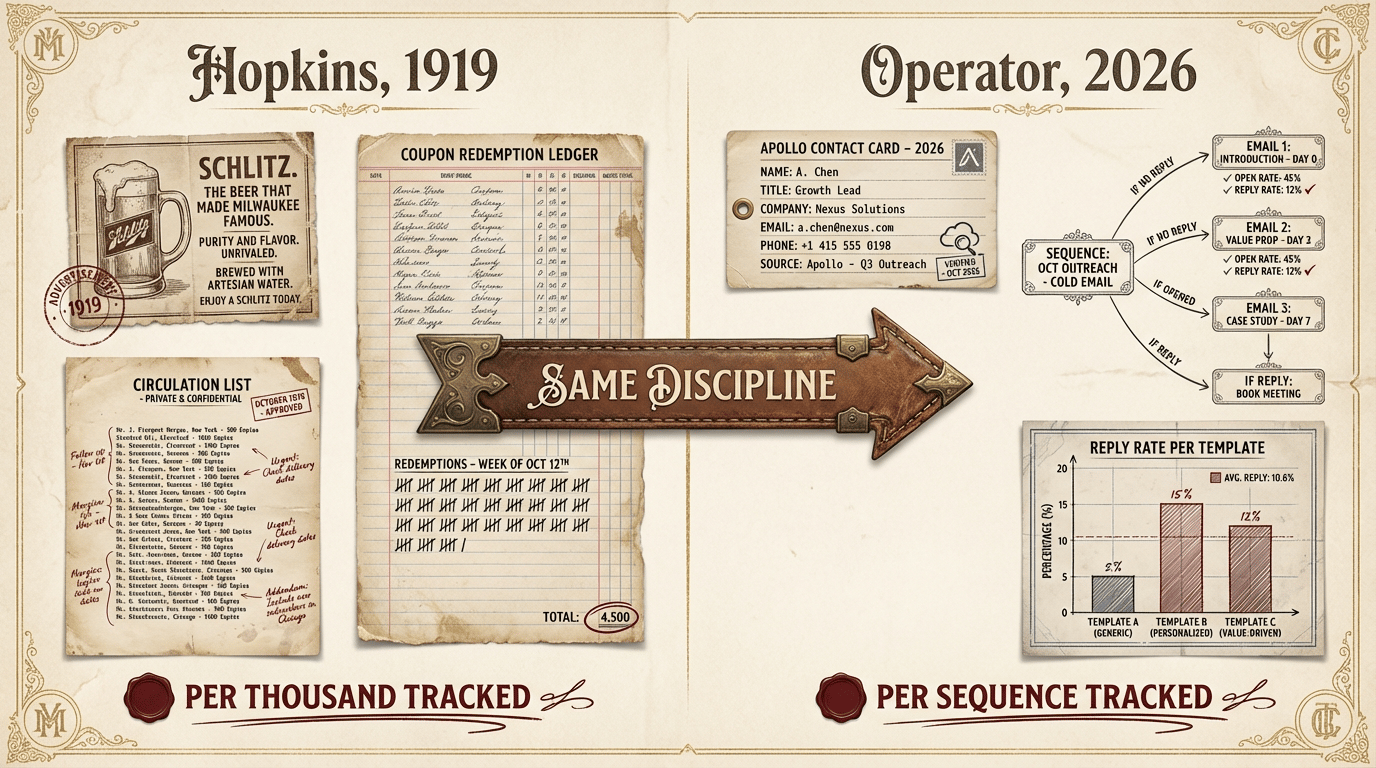
Per 1,000
Coupon return tracked per thousand pieces mailed. Variant isolation, not "advertising" optimization.
2026 cold email
Per template
Reply rate measured per sequence variant. Same discipline, two tools deep.
That campaign isn't an ad-history footnote. It's the discipline cold email keeps forgetting.

The two failure modes that kill cold email

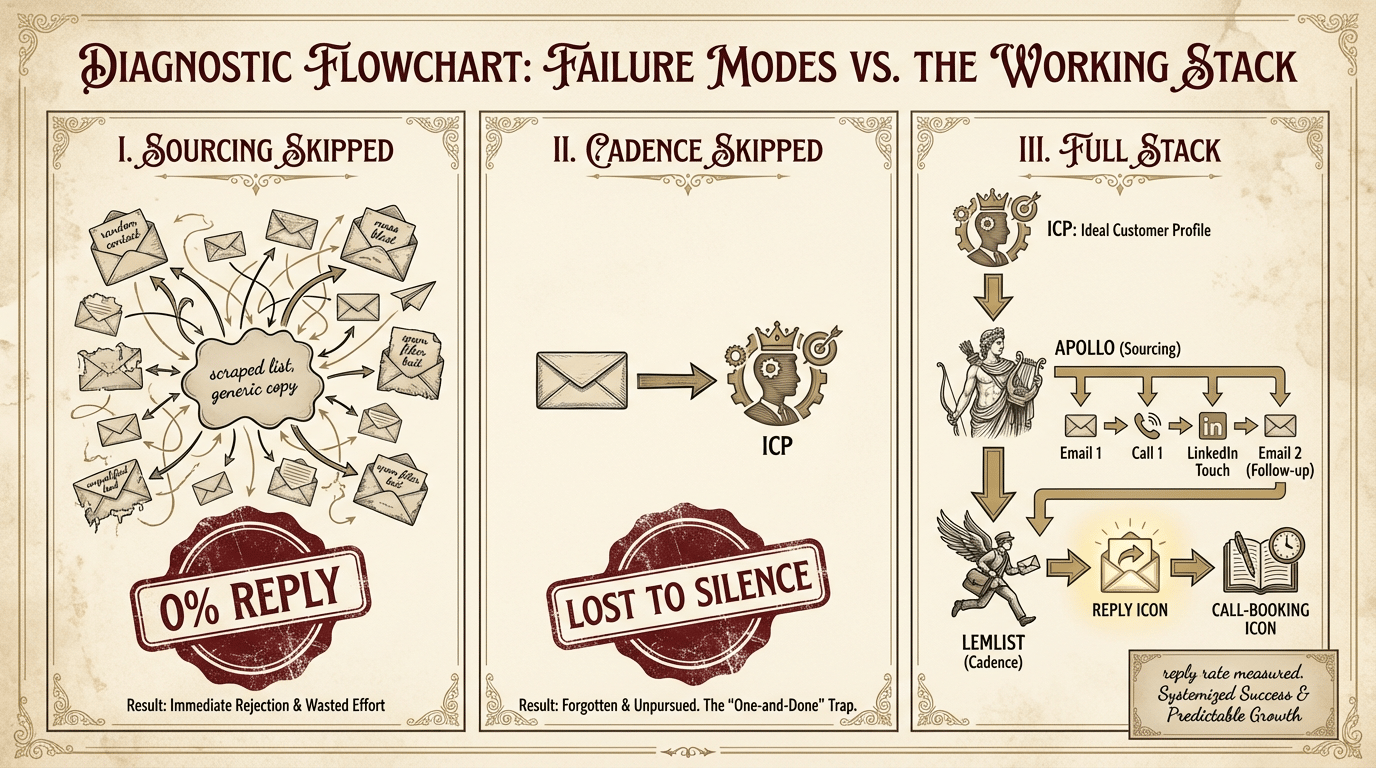
Failure 1 · sourcing skipped

1,000 generic emails to a scraped list, 0% reply rate, conclusion that the channel is broken. The list was the broken part — never the channel.

Failure 2 · cadence skipped

One email, no follow-up, no reply tracking. Any reply gets attributed to luck; every silence reads as rejection. The reply rate is invisible because the system doesn't measure.

Hopkins didn't mail to "general consumers." He mailed to specific subscriber lists with measurable demographic profiles, tracked the coupon return per thousand, and isolated which copy variant returned. The 2026 cold-email stack splits that exact discipline across two tools.

The stack, by half

Half 01
Sourcing — Apollo
250M+ contacts database. Surgical filters: title, headcount, location, last-funded date, tech stack, hiring signal, role change. Hopkins's circulation analysis at 2026 scale — 5 minutes for what a Lord & Thomas planner did in two weeks.
Half 02
Cadence — Lemlist
3–7 emails over 14–21 days. Variable-level personalization — custom images, dynamic intros, video thumbnails with the prospect's name. Reply rate measured per template variant.
Discipline
Iterate the variant, not the program
Hopkins's "coupon returned X per thousand" → today's "this sequence returns Y%, the variant returns Z%." Stack first, optimize second. That's the move.
Two-column 'Same Discipline' parallel: Hopkins 1919 column with Schlitz ad clipping, coupon redemption ledger, circulation list — 'Per Thousand Tracked'. Operator 2026 column with Apollo contact card, Lemlist sequence tree, reply-rate bar chart — 'Per Sequence Tracked'.

What the Apollo + Lemlist stack actually wins

  • Best-of-breed at each step. Apollo's contact database is broader than any all-in-one tool's native sourcing. Lemlist's deliverability + dynamic-personalization stack is deeper than any all-in-one's native sequencing. Each tool runs the discipline of its own niche better than a generalist would. The 2-tool "tax" (an extra login, an extra subscription) buys quality at both ends of the workflow.
  • Free-tier wedge for the audit. Apollo's free tier (600 credits/mo) handles a serious starter ICP — enough for ~3 weeks of qualified outbound at 50 prospects/week. The audit happens on free; the paid tier unlocks once the list-quality math is proven. No upfront commitment to know whether the workflow fits your motion.
  • Replies tracked at the template level, not the campaign level. Lemlist's reply-rate-per-template metric is the operator-test that makes cold email iteratable. You don't optimize a "cold email program" — you optimize the specific variant that returned. Hopkins didn't change his copy; he tested a variant. Same discipline.

Where the Apollo + Lemlist stack isn't the answer

  • Pre-revenue solo operators with no clear ICP. If you can't name your ideal customer in one sentence — title, company shape, problem they're trying to solve — the stack will make the sourcing problem worse, not better. 250M+ contacts is overwhelming when the filter is unclear. Solve ICP definition before you open Apollo. Skip the stack until you have an offer one specific buyer has paid for, twice.
  • Strict-compliance verticals (healthcare, regulated finance, legal services). Cold email is audience-side regulated — CAN-SPAM in the US, GDPR in the EU, TCPA for SMS, CASL in Canada. Industries with stricter overlay rules (HIPAA-adjacent outreach, FINRA-supervised marketing, lawyer marketing rules per state bar) need a compliance review before any sequence runs. Apollo and Lemlist give you the tools; the regulatory work is yours.
  • Inbound-first motions where the deal cycle is referral-driven. If your last 10 customers came through partner intros or word-of-mouth, cold email isn't your highest-leverage growth lever. Build the partner relationships, run a JV calendar, optimize the referral loop. Cold outbound is for operators who need to manufacture deal flow that doesn't exist yet — not for operators with a working flywheel they should compound.
Three-panel diagnostic: Sourcing skipped → 0% reply; Cadence skipped → lost to silence; Full stack → ICP → Apollo → Lemlist → reply → call-booking with reply rate measured.

Apollo + Lemlist vs. the alternatives

Same workflow runs on any of the three. The tools change; the discipline doesn't.

Tool Best for the cold-outbound job Where it wins Where it doesn't
Apollo + Lemlist Operators who treat sourcing and cadence as separable disciplines and want best-of-breed at each step. Apollo's contact-DB depth is the broadest in the category; Lemlist's dynamic-personalization + reply-rate-per-template tracking is the strongest on the cadence side. Free-tier wedge on Apollo lowers the audit cost. Two logins, two subscriptions. Workflow handoff between the tools (export from Apollo → import to Lemlist) takes 5–10 minutes per batch — fine at 50-row batches, friction at 500-row scale.
Instantly Operators who want one login for sourcing + cadence + warmup, with native deliverability infrastructure. Built-in email warmup (no separate Mailwarm/Warmup Inbox needed), unified contact DB and sequencing, generous sending volumes per workspace. The single-login pitch is real. Sourcing depth is shallower than Apollo's standalone DB. Personalization stack is thinner than Lemlist's. The convenience tax: lower ceiling on what each primitive can do.
Smartlead Operators who run cold email at high volume and need deliverability-first infrastructure (multi-account rotation, unlimited mailbox connections, native warmup). Best-in-class deliverability primitives — multi-account sending, native warmup, sub-account management for agencies running multiple clients. The volume-operator pick. Sourcing is BYO (third-party data feeds or manual import) — no native ICP-DB at Apollo's depth. Personalization is functional but not Lemlist-level.

Walkthrough — the 7-step cold-outbound workflow

  1. Define the ICP in one sentence. Title + company shape + problem. Example: "VPs of RevOps at Series-B-to-D B2B SaaS companies with 50–200 employees, struggling to consolidate sales-data pipelines across 4+ tools." If the sentence takes more than one breath, the filter is too vague. Tighten before opening any sourcing tool.
  2. Build a 50-row list in Apollo's free tier. Filter on the ICP from step 1. 600 free credits/mo is enough — each row consumes 1 credit for contact + 1 for email reveal. Don't go bigger than 50 on the first batch. 50 rows is enough to test the sequence; 500 rows is enough to burn the domain reputation if the sequence is wrong.
  3. Enrich for personalization variables. Beyond name + email, pull: recent LinkedIn post, last funding round, hiring signal, tech-stack signal. These become the dynamic-personalization variables in step 5. The richer the row, the higher the per-recipient relevance — and the higher the reply rate per template.
  4. Import to Lemlist. CSV from Apollo, mapped to Lemlist contact fields. Map the personalization variables from step 3 into Lemlist's {{firstName}}, {{company}}, {{custom1}}-style merge tags. The mapping is the bridge between the two tools — get it right at 50 rows, scale it later.
  5. Design the sequence. 3–7 emails over 14–21 days. Email 1 is the operator-test detail (Hopkins's "we boil our bottles" — what specific reason makes you worth the prospect's reply?). Email 2 is the soft follow-up. Email 3 reframes. Emails 4–6 add value (a relevant case study, a specific tactical answer, a useful resource). Email 7 is the breakup. Personalize the variable layer, not the entire copy — write one core sequence, vary the per-recipient detail.
  6. Run reply handling like a CRM. Replies surface in Lemlist's inbox view. Tag responses (interested / not interested / wrong contact / wrong timing). Hand qualified replies off to your call-booking flow within 24 hours — the half-life of a cold-email reply is roughly that. Late handoffs are deals you'd already won and lost.
  7. Measure reply rate per template, not per campaign. Lemlist tracks reply rate per sequence template. After 50 rows × 5 emails = 250 sends, you have a signal on which template returns. Iterate the variant, not the program. Hopkins didn't change "advertising"; he tested a variant. Same discipline at 2026 scale.

Sourcing first, cadence second. The discipline is older than email itself; the tools are 2026.

Start with Apollo's free tier →